
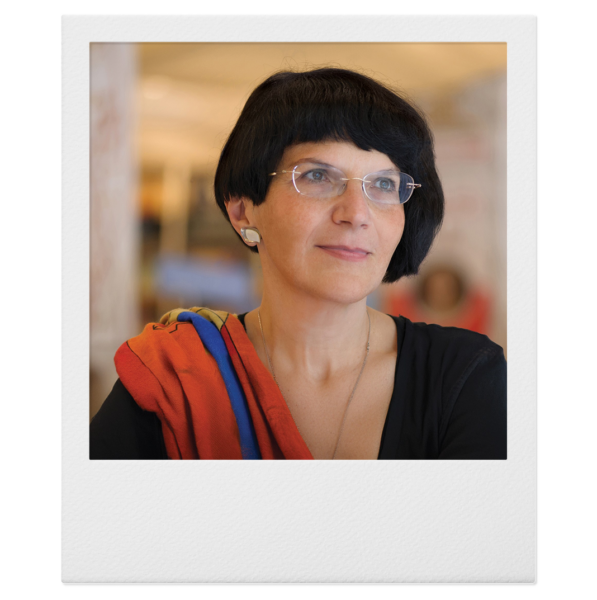

In 2020, on the occasion of the thirtieth anniversary of Humanitas publishing house, its founder Gabriel Liiceanu looked back, in a text previously unpublished in English, the opening pages of which we publish here, on that decisive moment when, amid the still-warm ruins of Ceaușescu’s communism, an editorial, cultural, philosophical, and perhaps even political project emerged, emblematic of a Romania finally liberated, yet still grappling with every kind of crisis, economic and moral.
Dialogos
***
“If the entire country had found its way as
Humanitas did from the very beginning,
without a doubt we would have had a very different Romania today.”
Lucian Boia
Everything began with a phone call from a friend one dreary winter day at the end of January 1990. History had been overturned and Romania’s cultural institutions, which were searching for a way forward after being ideologically bedridden for decades, were waiting to be renewed from the top down. Andrei Pleșu was named Minister of Culture in “the first post-revolutionary government of Petre Roman.” “New people for new times,” was the slogan of the moment. And the new minister, who had replaced Suzana Gâdea in the ministerial office on the first floor of the central wing of Casa Scânteia, the House of the Spark press building, was deciding who could replace the former directors of theaters, presses and magazines, libraries, museums and philharmonics, basically everything pertaining to the cultural life of the country. Wasn’t it only natural to regain a cadence of normalcy and reconnect to the traditions of Europe through these new appointments? Most urgent were the places with complete historical ruptures, the emblematic institutions of communism. At the forefront of those that had lost their reason for being when the old regime was abolished were the History Museum of the Romanian Communist Party on Kiseleff Boulevard (formerly the “Tzigara‑Samurcaș” museum) and the Political Press in the left wing of the House of the Spark. The profile of the latter, founded in 1954 under Valter Roman and directly connected to the ideological department of the Central Committee, was well defined: its mission was to publish “Marxist-Leninist classics,” “the documents of fellow parties” in other countries, and, starting in 1965, “the works of the party’s General Secretary, comrade Nicolae Ceaușescu.” On the phone that day, the friend whom I had received as a gift through “Noician decree” from philosopher Constantin Noica one Sunday in 1968, and who sometimes liked to introduce himself as “a character in the blockbuster The Păltiniș Diary,” asked me if I would “help him” (“I hope you won’t leave me on my own!” he’d say to his friends) either by coming alongside him as a state secretary for culture, or by transforming the Party’s press into one for the humanities. I remembered the vast cultural projects we once carried out together against all hope, with the desperation of those who stubbornly refuse to stop dreaming even when history seems to have placed stone slabs over their destinies forever. I remembered, in our discussion that morning, how years ago, walking in a forest on the banks of the Neckar, I had confessed with what voluptuousness I would have bestowed our libraries on all of Romania. If we ever escaped that long night of history. If we ever escaped . . . The truth is, at 48—my age at that crossroads moment—I was haunted by an almost unhealthy Enlightenment calling, and imagined that with a handful of brilliant manuals like the one by Salomon Reinach, Eulalie, or Le Grec sans larmes, and a few thousands editions of the great world authors now free of censorship, we could have healed an entire country from the wounds of communism in two or three decades. “Think about it,” he said, “everything that seemed just rambling then can become reality any day now.” I answered that I chose without a moment’s hesitation to work on the press. A week or two later, on February 1st 1990, crossing the courtyard between the central wing and left wing of the House of the Spark (it had already been renamed “The House of the Free Press”), Andrei walked into the headquarters, that had become uncertain overnight, of the former-new publishing house. I would become “anointed” following a ministerial order as the director of an institution that, for the moment, no longer had a name.
We headed toward the conference room. There, in tense silence, the entire staff of the former Political Press was waiting for us. I was struck by the hardened faces of the “sixty-three employees” that seemed straight out of a room in Madame Tussaud’s wax museum. We sat down at the “chairman’s” table, covered in red velvet, where the party secretary periodically held meetings, and along with casting out the demons of the West’s “putrid culture,” “political briefings” were given and “comrade Ceaușescu’s thinking” was interpreted. I remember with strange precision the speech Andrei Pleșu gave then. He opened with a short overview of fruitful friendships in cultural history, noting that it was elective affinities that bore fruit on the spiritual level. In our case, he then said, friendship was the welcome opportunity for a fully-informed choice and thus, the new minister hoped, the guarantee of success. Neither he nor I knew then that the most beautiful thing connecting us, that spiritual relationship stamped with the seal of Noica’s authority, would soon become the leitmotif of a smear campaign that would continually hound us. For its creators, friendship had never been anything other than a relationship of cronyism: you scratch my back, I scratch yours. The new publishing house that for him, as well as for myself, was being born of a drive akin to raising a church, would be constantly besmirched by the venom of professional slanderers. Later, this very campaign, that was so perfectly concerted and cropped back up in public with suspicious regularity, carried out on television, in newspapers, and on-line by the same team trained in the techniques of compromising others, made me believe that during an era when history was still unfolding, stirring up the hatred of scoundrels was a sign of success. The battle beginning then was between those who wanted us to remain stuck in an unspeakable past and those who burned with impatience to find a cure for our minds damaged by decades of harm. And the most readily accessible cure was uncensored books, the only one that could make you think for yourself. We as a people would be healed –both Andrei and I were convinced of this – through reading. “I will ask the director to communicate the name of the new press to me tomorrow, if possible,” the minister said before leaving the room. And he added from the doorway: “Have a good day at work, comrades!” But he was only able to get a few strained smiles from the people there.
The previous evening, the word humanitas had come to mind in the context of the Letter on Humanism. There Heidegger translates the word paideía, which the Greeks used for “soul formation,” as the Latin word humanitas. The paragraph had remained vividly in my mind because it was full of italicized words. Here it is: the term humanitas is first used explicitly as an object of reflection and aspiration during the time of the Roman Republic. Homo humanus is opposed to homo barbarus. Homo humanus here is the Roman who exalts Roman virtus and ennobles it, incorporating the idea of paideía taken from the Greeks. These Greeks were the Greeks of the late Hellenistic period, whose culture was taught in schools of philosophy. It concerns eruditio et institutio in bonas artes, “the cultivation and formation of virtues.” Paideía understood in this sense is translated as humanitas. The word paideía is also found in the subtitle of The Păltiniș Diary: “A paideic model in humanist culture.” Culture now is no longer the simple accumulation of knowledge and a snobbish polishing of the mind. Precisely because it moves into the territory of values, because it tries to discover the meaning of goodness, justice, truth, courage, piety, etc., it enters into the equation of “the formation and cultivation of virtues,” it is paideía understood as a propaedeutic to social ethics. A press named Humanitas would be a tool for the education of the soul. This Latin word would carry within it a secret panache even as it circulated inertly on administrative documents, tax forms, invoices, contracts, budgets, annual reports, and so on. It would allude, albeit enigmatically, to the recuperation of a world in which eternal human virtues had been banished in the name of other “class” virtues. Through its very appearance, Humanitas would revert and move into a positive register everything that for four decades had been made part of a register of abjection, of crimes, lies, duplicity, treason. . . Above all, a press that would take on the Latin term for Hellenic paideia would propose the restoration of the semantics of universal values. To the extent it showcased the radiance of individually cultivated minds, this name would become the emblem of collective moral healing. That’s one thing. But alongside the urgent need to erase the damage done to social morality, a second kind of repair was also needed. It concerned history, both national history, whose mythic emblem had become the simple leather shoes of the Dacians, as well as history that recalled our genus proximum as Europeans. It was essential we reconnect to the spiritual genealogy of the West, from which we had been disconnected through that very hiatus marked by communist ideology. At stake wasn’t only “the pride of a person born into a small culture,” but also that of someone born in the postwar East. Humiliated in the fundamental facts of our existence, a few of us burned with impatience to show the “other” people from the West that, in spite of everything that had happened to us, we had remained like them, meaning in essence Europeans. With this aspiration, I crossed the threshold of the old Political Press. Europeanness was the capital no one, even if they took everything, could steal from us. As an intellectual who had come out of the postwar East, I brought with me into the new era not only the ordinary wounded pride of those from small cultures, but also the essential pride of having remained, on the other side of a history that had tried to transform us into another human species, a European.
Translated from the Romanian by Monica Cure.
This text is an excerpt from Gabriel Liiceanu’s essay Povestea insulei Humanitas, unpublished in English, which was published to mark the thirtieth anniversary of the founding of Humanitas Publishing House.