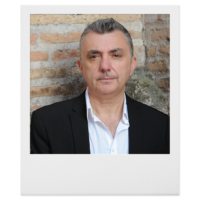
Péter Nádas, the great Hungarian novelist, died suddenly on 26 August, in Gombosszeg, the village where he had lived for many years. At the beginning of July, he had expressed his enthusiasm at the prospect of being among the first authors published by Dialogos. He had personally taken care to ensure that his two translators would be available from 1 September, and had undertaken to send us his essay by the end of August. During our exchanges that month of July, he had sent me a PDF of Zeugen des Lichts, a magnificent book published in Germany by Verlag Thomas Reche, containing photographs taken by Péter Nádas himself (he was also a photographer, whose work has been exhibited at several major institutions, beginning with the Kunsthaus Zug). The book contains an unpublished text, one that had never before appeared in Hungarian, French or English.
When news of his death reached us, just a few days before the deadline he had set for submitting his unpublished essay, my first thought was to contact his wife or those close to him to ask whether the text might be somewhere on his computer. But I soon came to feel that such an impulse was misplaced. The time for mourning had to be respected. And yet Péter Nádas had sent me this text, Zeugen des Lichts. A text known to very few readers. A text whose meaning, in the wake of his death, becomes all the more unsettling. It speaks, among other things, of death. Of death and the spirit – or rather, the Spirit. He refers to the heart attack from which he survived, at the age of fifty-one, after his heart had stopped beating for more than three minutes. I learned from his publisher that Péter Nádas had delivered this text in a German Benedictine monastery. Its theological beauty, then, was inseparable from a particular setting.
I obtained the Hungarian original and entrusted it to the two translators whom Péter Nádas had contacted a few months earlier, and who have for many years accompanied the journey of his work from Hungarian into French and English. We discovered that the author had made slight revisions to the text for the German edition, in a language in which he was entirely at ease.
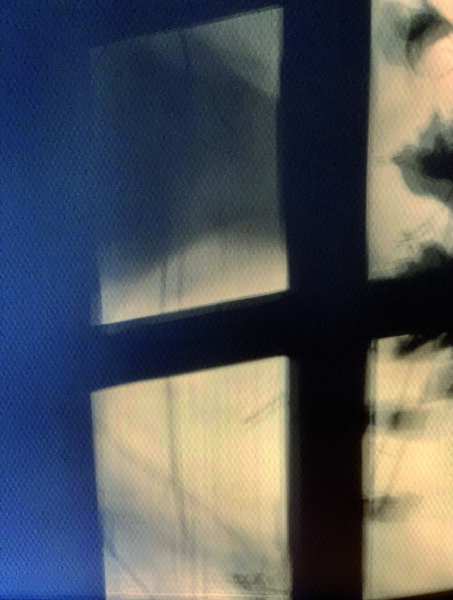
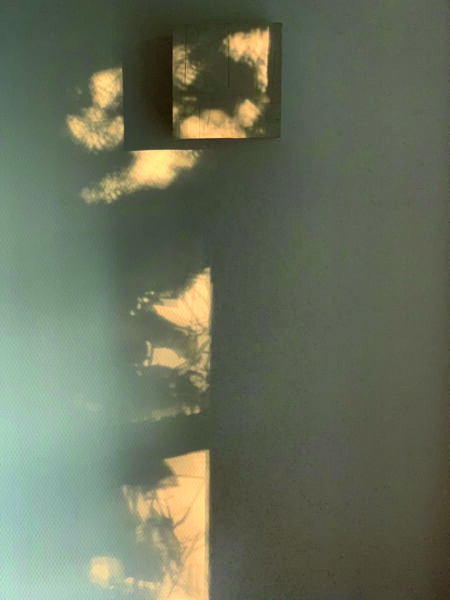
Dialogos presents the text, together with translations made from the original Hungarian, with three editorial interventions: we have retained the beautiful title of the German edition, included the passage from the Gospel of John to which the text refers, and removed the two direct addresses to the congregation of worshippers and members of the religious community to whom Péter Nádas had spoken. We have chosen three photographs from the German edition to accompany this essay.
Christian Longchamp
***
But he spake of the temple of his body.
John 2:21
It’s not the tangible I’m concerned with, not a temple, not the body, not my own or that of others, not the semantic fields associated with them, not their design, not their membership or their adherents, not their agencies or institutional roles, but the place of the two concepts.
Where in our consciousness the concept of the body is situated within the circle of other concepts. How the temple is related to the body. And what is the source of John’s surprising and to this day unprecedented association of ideas. I will be very personal with my questions, for which I ask for your indulgence at the outset. Is the body outside the temple. What is the body of the temple. It’s nave, its chest. How does the organ huff and puff inside it, and how the lung lobes in a fever. What is the body. Who am I. Am I identical with my body. I am personal in accordance with my profession as opposed to science, which won’t allow the personal voice, though it cannot exclude it entirely. I will insist on just one specific person, John, who places these two concepts, the body and the temple, in a reciprocal relationship. He sees the light shine in the darkness at the very moment when the darkness won’t admit it. As if he could locate it in anticipation of the groping of cosmologists regarding the unknown density of the dark matter of the universe. And this makes one cry out in spite of oneself. How very true. Creation, how easily it lends itself to description. How simple everything is. John speaks in dualities in our language attuned to dualities, yet I wouldn’t call him a dualist. Is there an individual who lives outside of the temple of his body, even if for a single moment. A rhetorical question that contains its own answer. I say unto you, Socrates, no body exists outside of its temple, answer the obliging youths in the Athenian groves upon hearing such questions. Not even at the moment of death. I once died for three and a half minutes, so I know what I am talking about. You remain alone with the full contents of your consciousness. For lack of sensation, you have no other universe outside of the content of consciousness. From which it becomes abundantly clear that the full content of your consciousness is identical with the complete history of your physical observations and conceptual understanding. I emphasize: complete. Which is the infinite that has existed ever since eternity. For lack of sensory imput, which is now a redemptive deficit. For the first time it is yours, and the full content of your consciousness, sensory perception, understanding and judgment is made immediately available to you in the form of sensory perception, comprehension and judgment. What has never happened before happens in death. You sense the personal as part of the eternal. There is no remembering, because there is not, nor was there ever, forgetting. Furthermore, for lack of physical perception, there is no reason for you to dispose over anything; you have, in fact, nothing to dispose over. And yet you consider. Which means that not only you, but creation, too, lacks symmetry. Your thinking is self-propelled, it does not cease, but its energy does not originate with you. You are surprised to learn that your thinking has been nourished by eternity all along, and that you have been a participant all along. There is nothing that we didn’t know to begin with. You try to catch up with your mind. Except, the constraint of continuous sensory perception barred your access to the acknowledgment of the knowledge you already possessed. Socrates was right in this, too, you can learn only what you already know.
Tastes, sounds, sound-groups, scents, words, sentences, judgments, touch, impressions, each according to its own nature form part of the storehouse of the mind; in short, the full operation of perception and understanding comes to the fore in your own consciousness along with your judgments of various kinds, and with the acceptance or rejection of the subject in question, along with the internalized collective sets of concepts. What’s more this at the moment of the departure of the discovered and undiscovered chains of concepts and the net that connects them. Everything that I know or think I know with all that I know that I don’t know, that I had good reason not to acknowledge, whereas I’d acknowledged it. Self-defense is at once my personal and my inherited trait. I had to be on guard. The structure of consciousness and not its subjects bears with substantial significance. My concentration on the factual again and again obscured the substantial from view. The alertness obscured existence. The deficits, the omissions, the desires, the aspirations, the wicked emissions, the longings, compulsions, stubbornness and aggression, the many kinds of contingent rebellions hid it from view. There is no lesson to be learned. On the threshold of death, when the cardiograph omits no signal, only a monotone whistling sound, thinking reveals its inherited structure. But I see the materiality and historicity of contents close in on themselves all the while that with its interconnections, the contingent objective content of consciousness surpasses the universal. I grasp how I am bound to the cosmic. Hearing such an account, neuroscientists who have never died will at most give a dismissive shake of the shoulder, a delusion, it’s due to what remains of electric energy in the brain
Just as my death and my birth are inseparable. You must be reborn, says John. His imperative sentence is as hesitant as if he himself had been reborn, except he would rather not hawk his wares, he wouldn’t like to make others feel uncomfortable. The wind blows where it pleases, you hear the sound but cannot tell where it comes from, or where it is headed, and this is the case with whoever is born of the Spirit. He neither remembers nor forgets. It is like the will be and the has been exchanging glances and adjoining, and even looking outside of themselves, looking upon themselves as well as the universe, where at every moment energy detaches itself in mighty lumps from its glittering golden and reddish sources.
A vision, too, is merely the translation of collective knowledge into linguistic or pictorial form.
It would also be good to know whether the body subsumes us, or we subsume the body. At times it seems as if the body bore with greater physical weight than what the scales indicate. What is it in our weight that cannot be called the “I”. Does a man’s being have physical weight. Nota bene, the spirit. How can I be the others, and in what way do I remain me in the eyes of others. How can collective knowledge be greater than I am, considering that it has no dwelling place and has less memory than a forgetful individual. Or on the contrary, what right have I not to be me every single moment. But in that case, why does my self lack wholeness. How can such an insult come to me in creation. After all, we do not welcome the fact that our body is pieced together from hereditary factors, genetic codes and sequences, and by far not according to our wishes, and with no room for correction. Put together as if on a whim. A patchwork, but not in accordance with linear descent. How easy it would be like that, not from our father, not from our mother, they’re evidently in it of course, and not directly, we don’t even recognize them, but according to templates of earlier origin, assembled ad hoc from individuals and elements originating from who knows what collateral line, and all this together with that certain something that effectively is our innermost selves, and anyone who looks at us can see it. Our intonation, too, gives us away.
John calls it the spirit. Others call him the evangelist of the spirit. An eagle not blinded by the light of the sun. People have also counted the number of times John mentions the spirit in his gospel. I took the trouble to check. Which doesn’t mean that I know what we should call the spirit. St. John the Baptist says he saw it descend from the sky in the shape of a dove. The dove is a synonym for the spirit and no one has yet succeeded in separating the two. We have an agreed upon word for the spirit that every person understands but each person will interpret it individually. He doesn’t have to be a nominalist to do so. I reared up a little bird that had fallen or was crowded out of its nest, a common redstart, and until I let him fly away, we shared a common language. At dawn, when he was hungry, I started awake. When he finally took to flight one afternoon from my palm, he returned the following morning asking not for food, but for water. Or else it needed the ritual of being offered food and drink. I don’t know. Or its thirst was greater than its hunger. John is inside God. He has no need to understand the obvious. He doesn’t give us the story, he gives us the substance. The first sentence of his Gospel is a direct logical introduction to practical cosmology. It portrays the state preceding the Big Bang. He is remembering something contained in the collective memory. Everything. One. Nor is there need for definition. The whole is contained in the whole. In his first sentence, the origin of things and the reason for things are not separate. The energy of the whole has no detached particles and no dross. In which case, how could another soul with his utterly strange chest, feet, arms and ears awkwardly unsuited to him be a stranger to me. Or the birds of the sky and the plants sprouting from their seed. Natura naturans and natura naturata. From their characteristics I can just barely deduce how these things function in different people. No one has learned the act of interpretation, yet has mastered it. It is like the epidermis, the most extensive organ of the body. It absorbs and it relays. It is the same with the two great sciences of the soul, theology and psychology. The knowledge they contain is strictly indirect, for it is based on inference and taxonomy.
And now, by way of closing, a confession. At the turning point of my adulthood, when I withdrew, when I turned my back on the world on which I turn my back to this day, on the river’s edge I found a tree that became the sure station on my long-distance runs and strolls, where I almost always stopped. Not always when I was running, but when I was walking, every time. If I did not stop but adhered to the rhythm of my intake of breath, it felt especially good to approach it, to pass through its charmed circle and then gain distance from it. A near-painful experience. It feels good to go to church, but it feels equally good to painfully stay away. The tree was a poplar, though I wouldn’t say it was an ordinary poplar that towered above the riverside willows and young saplings. One might say that it raised its canopy above the river bank and the carriage path with impeccable architectonics. Surely it needed this perfectly crafted effort because the riverbank would have collapsed had the poplar not succeeded in keeping the soil bound under itself. In this way, not only did it build its own fundament with its roots, but with its knotty offshoots and convolutions it saw to it that the floods shouldn’t sweep the soil from under it, what’s more, leave the rich alluvium and debris behind. It gathered, layered, and constructed a mound for itself, it built a peninsula against the current. All this with determination. To which I hasten to add that the place was predetermined, the insistence was predetermined. In the case of the place chosen, the object chosen and the chosen individual, the one thing we don’t know is who did the chosing. The interrelationship is by all odds so binding, it will not release either the object, nor the individual. The tree stood towering above the river. On this short stretch it saved the riverbank for others. A mere forty meters from it, the riverbank collapsed, revealing by all odds ancient mass grave. In a single sediment, the floods created a proper cross-section of the bones of the dead.
Noone can follow the crown of a poplar with his eyes, yet anyone can listen to the syncopated, rustling rhythm of its lively leaves. Surprisingly, its music is not in sync with the direction of the wind, as if, with its throng of rustling sounds it meant to defy the direction of the wind itself. Or put another way, the wind is no match for the throng of its rustling sounds. By which I mean to say that the chosen objects of chosen places, whether they be objects of art or objects of nature, bear with mythical significance. Life trees. World trees. This is how far my temple-tree took me back in historic time. What’s more, the chosen place takes us beyond the mythical, and not just me, but every single temple. It takes the human body from its own temple back to a magical place, where bodies and objects stand as direct symbols of each other. But for this very reason, I had to be on my guard by this tree, I had to decide what to allow and what not to allow. After all, not only man had his chosen places in his own his prehistory, but way before that, the primates as well. My tree became a place of prayer. To my great good luck, I couldn’t lean my back against its trunk. I would not allow myself this luxury. I would just stop for a moment on the edge of the bluff, among its intertwined and convoluted roots. This tree inclined me to prayer. I was prepared for it. I didn’t even have to be on my guard to make sure that my prayers shouldn’t have a pantheistic character. They didn’t, whereas at the time I read Giordano Bruno with great pleasure, and could have proceeded in that direction. No pagan regression. No nature worship. As a human being I truly have no reason to succumb to self-adoration, no reason to create idols or turn the tree into an altar, lest I think that I am praying in a temple. Yet we must not forget the mighty ritualistic and spiritual significance that the living tree plays in man’s cultural history. I will not forget.
During my long lifetime I could discuss spirituality or devotion to Christ with only two of my fellow men. Which is not little. On the contrary. It is very much. I took them to the tree. On one of them, a man younger than myself, it made no impression whatsoever; okay, fine, he said, a temple-tree, but it’s certainly not a cathedral, nor a basilica. It’s more like a small village chapel of sorts. Which made us laugh, and this laughter became the temple of our bodies. The other, a woman older than I, knew from a distance what I wanted to show her and what I meant to convey by it. Afterward, she visited the tree regularly, and at times would even tell me about it.
Translated from the Hungarian by Judith Sollosy.