Jasenovac lies some one hundred kilometers from Croatia’s capital, to the east along the River Sava. It is a town of around five hundred inhabitants, with a train station, a late Baroque church dedicated to Saint Nicholas, a farm, and a gravel pit. It’s a gentle, quiet region, with long spells of thick autumn and winter fog and summers ruled by empires of mosquitos. Here flows the River Una, following for the majority of its course a path through neighboring Bosnia and Herzegovina before emptying into the Sava not far from Jasenovac, and here too, for hundreds of years, stretched one of the more striking civilization-defining borders of Europe. On one side of the river, after the peace treaty signed in Sremski Karlovci on January 26, 1699 by representatives of the Holy League (the Habsburg Monarchy, the Venetian Republic, the Polish-Lithuanian Commonwealth, and the Russian Empire) and the Ottoman Empire, lay the Christian West, represented by Leopold I of Habsburg, who bore the title of Holy Roman Emperor, while on the other lay the Muslim Orient, which was represented by Sultan Mustafa II. And as it happens with European borders, the border along the Sava was not an outer one but an internal boundary within Europe. European borders speak of fragile, fluid European structures, of the identities from which Europe is composed, not of worlds outside Europe.
Once drawn, the border influenced the identities of the people living on different banks of the river. Those living under the emperor in Vienna became one people, while those living under the Turkish sultan became another. But as a river is not an impassable boundary, and as people are curious and sociable by nature, never are such border-created identities complete or without ambiguity. Alongside the majority on each side, a minority of those who are other, who are different, also takes shape. Within people themselves, dual or multiple affiliations emerge. People of the borderlands always carry more or less strongly developed cross-border identities within. They are at once a source of mutual understanding and accord, and of frenzied, self-destructive hatred. One’s own identity is affirmed through hatred of the other. This is how a person nullifies or kills the other inside himself. Just as understanding one another and reaching agreement are how one frees oneself of fear of the other. Both emotions are deeply European.
On Sunday, April 6, 1941, Hitler’s Germany invaded the multi-ethnic, multi-confessional Kingdom of Yugoslavia, a country that had already been shaken by internal ethnic conflicts. The Kingdom completely collapsed within just a few days, and the Nazis and their allies—Italy, Hungary, and Bulgaria—divided up its territories. In accordance with Hitler’s vision, the Independent State of Croatia, or NDH, was created as a satellite state comprising Croatia and Bosnia-Herzegovina, whose administration was given to a group of extreme nationalists led by the one-time lawyer and former member of the Parliament of Yugoslavia, Ante Pavelić. Pavelić modeled his Ustaša regime after the Third Reich, introduced racial laws, and that same spring began the disenfranchisement and killing of Jews, to which he added something that did not particularly suit the Germans: the disenfranchisement and killing of Serbs, who comprised nearly a third of the population in the NDH’s territory.
The establishment of concentration camps, in which Serbs, Jews, and communists were interned along with Freemasons and pre-war democratic-leaning civic politicians, began just five days after Pavelić’s state was proclaimed. Eugen Dido Kvaternik, who headed the Ustaša Surveillance Service and the secret service branches, and also served as commander of the camps, began the planning and construction of the Jasenovac concentration camp in the middle of 1941. He appointed Vjekoslav “Maks” Luburić as camp commander. Luburić traveled to Berlin, where he drew up plans for the large camp near Jasenovac, modeling it after Sachsenhausen, a Nazi camp that had been established as early as 1936. Construction of the barracks began on the marshy ground near the town in mid-July 1941, leading, before the spring of 1942, to the completion of a camp complex consisting of five smaller, interconnected camps situated on both banks of the Sava. The site functioned in part as a labor camp, with a tannery, brickworks, sawmill, power plant, and a forge for the production of chains, but it simultaneously served as a site for mass liquidations of people. In contrast to the classic Nazi extermination camp, which used gas chambers and crematoria as part of an industrialized killing process, in Jasenovac the liquidations took place by hand, through the slitting of throats, blows delivered with mallets to the backs of heads, mass shootings, and hunger-induced exhaustion. There was also a difference in the record keeping: unlike the Nazis, Pavelić’s Ustaše were not meticulous in documenting their actions. And there was a difference in the level of discretion: the concentration camps of the Third Reich were secret sites, hidden away from the public and frequently displaced onto occupied territories to the east, while Jasenovac in the NDH was widely and publicly known, an instrument used to intimidate those who disobeyed.
The names of 83,145 individuals killed at Jasenovac—men, women, and children—are known. It will never be possible to know how many have not been identified, but the total number of victims may be as high as 100,000, consisting mainly of Serbs, then Roma, Jews, and anti-fascist Croats.
Thanks to Josip Broz Tito and his Partisans, Yugoslavia was restored as a state in 1945, this time as a federal, multi-ethnic republic. Communist Party rule was established, all other political parties were banned, and the country’s already weak and ineffective democratic traditions were destroyed. A grand legend was crafted about the struggle for freedom and the heroic resistance against fascism, a struggle in which all Yugoslav peoples took part, but the treatment of Jasenovac and the Ustaša concentration camps in the legend remained ambivalent. On the one hand, the number of victims of fascist terror was exaggerated, in part to secure German war reparations and international aid, and on the other, Jasenovac was discussed or written about only with great caution and sparingly, for fear of harming the country’s inter-ethnic relations. If one spoke of Croatian wartime guilt and the Croatian fascists, then in the very next sentence one had to say something about Serbian wartime guilt and Serbian fascists. And when people talk like this, they usually end up saying nothing at all.
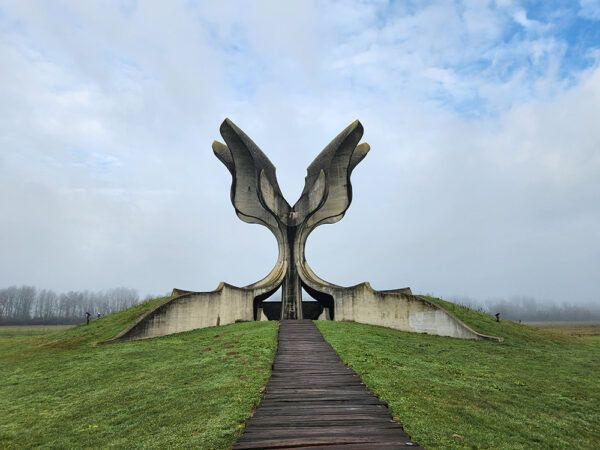
A full twenty years after the war’s end, in 1966, a memorial complex was built on the site of the main Jasenovac camp, based on a design by the Belgrade architect and sculptor Bogdan Bogdanović. At its center stands a massive abstract form that resembles a flower and is made of reinforced concrete with an approach down a winding path laid with carbolineum-treated wooden railway ties. One can only approach the white, reinforced-concrete flower on foot as it emerges from the precisely contoured, grass-covered landscape, as if a world from the past lies just beneath the surface. The path stretches for several hundred meters. If one walks it on a hot summer day, the coating on the wooden ties gives off a scent that’s familiar from our childhood. This was how railways smelled in the seventies and eighties of the last century, both the tracks themselves and the telegraph poles that were treated with carbolineum. The scent recedes somewhat in autumn, winter, and spring but is still perceptible. And it marks in a striking manner the experience of anyone who might walk the path towards the Jasenovac flower.
The first thing the camp’s designers learned from their German teachers was that the site had to be strategically positioned within the railway network but that it also needed to be connected to the outside world by a terminal spur, a dead-end track. The line does not pass through the camp. It terminates at the camp. If one examines a railway map, Jasenovac appears like a miniature Auschwitz. Just as with Auschwitz, Jasenovac could be reached only by train. Walking along the path toward the gray-white flower, one becomes aware of that distinctive olfactory sensation: the scent rising from the wooden railway ties under one’s feet is the very same scent those who were transported to this place in passenger and cattle cars between 1941 and 1945 would have experienced. Everything but the scent is different now. Everything else has disappeared with time. The Ustaše destroyed the camp complex after the war, and the new authorities made no attempt to preserve it in the condition in which it was found, which, in the end, would have been impossible given the damp soil and unfavorable climatic conditions. But thanks to Bogdan Bogdanović, an authentic remembrance of the camp has been captured in what is in fact a most dramatic manner: smell. Jorge Luis Borges remarks somewhere that the memories that stir us most deeply are those linked to smells and tastes, for they are typically surrounded by “abysses of oblivion.”
Bogdanović’s Jasenovac monument is devoid of big words, slogans, symbols, and the other ephemeral hallmarks of the era. At the destination, in the monument’s concrete womb, a single stanza from the poem “The Pit,” by the Croatian poet and Partisan Ivan Goran Kovačić is inscribed in bronze, rendered in the sculptor’s own hand, consisting of a few abstract, nearly astral lines:
Photo © Ivan Posavec
Where’s the small bliss, the flash on window glass,
The swallow’s nest, the breath from the garden?
Where is the creaking cradle on its path,
And golden house dust in ribbons of sun?
Besides this, there is only one other place, on a small bridge next to the path of wooden ties, where a ground-plan of the camp is cast in bronze, stylized almost to the point of abstraction, and that is the extent of any concrete reality. Near the entrance to the memorial complex, outside the area designed by Bogdanović, stands a single-story building housing a museum of physical artifacts from the camp, of the sort we’ve grown used to seeing while traveling through contemporary Europe. Nothing we see or hear there, nothing that belongs to the world preserved in documents or that reaches us through our sense of sight and hearing, will be new or different. People depend on their habits. Habit, along with oblivion, is the best anesthetic and anxiolytic.
Bogdanović was a renowned Yugoslav artist, the creator of numerous monumental sculptures, a writer, a theorist of architecture, and a surrealist. While he was an unconventional and free-spirited person, he held a university teaching position, served as the mayor of Belgrade, and stood out as one of the most striking intellectuals of his era—until late 1987, when he took a stand against Slobodan Milošević. His book Dead Ends: the Mental Traps of Stalinism, published in Zagreb in 1988, was the first intellectually coherent anti-Milošević and anti-nationalist manifesto in Yugoslavia at the time, written and published years before Milošević would initiate the war. Naturally, his persecution began immediately, continuing until he went into exile in Vienna, and was especially noteworthy in that it was not carried out by the regime’s organs of repression but ostensibly by spontaneous masses of the people. In the hallway of the building in which he lived someone scrawled the graffito “Ustaša” with arrows pointing to the entrance to his apartment. He passed away in Vienna in 2017 and was cremated. In accordance with his will, his ashes and those of his wife were interred beside the monument to the Jewish Victims of Fascism and Fallen Fighters in Belgrade’s Jewish Cemetery. The sculpture there, too, is his work, but this was not the only reason the couple were laid to rest in a cemetery belonging to a different religious tradition, for while both were atheists, they were indeed of Orthodox Christian heritage. Being a European means, among other things, being someone you are not, being your neighbor, an eternal minority. Being a European means being an emigrant, living forever on both sides of the border where you were born.
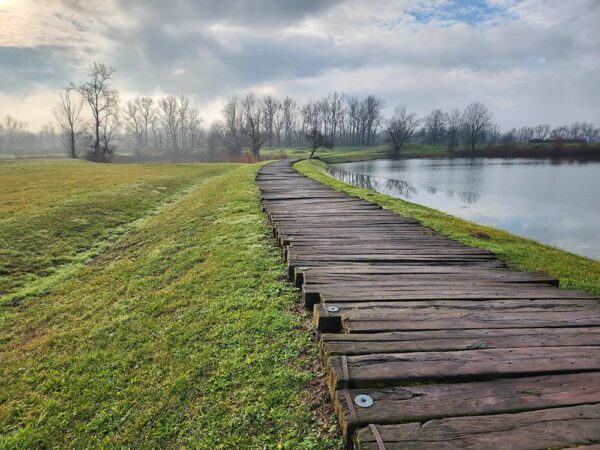
But I’ve been recounting all this because of the odor of carbolineum as we make our way towards the Jasenovac flower on a sweltering summer day, our hearts ready to burst from our chests in a sudden surge of emotion. Even though we know we’ll encounter the smell again, we can’t truly grow accustomed to it. The mixture, which derives from the coal tar used to coat the ties, contains something that connects us more than any document or any photograph to those who never returned from the camps. And not just from Jasenovac! The scent is what connects us to the rail system, whose chief dispatcher was Adolf Eichmann, and is the defining odor of our century of camps.
For some time now, however, neither railway ties nor telegraph or telephone poles have been made of wood but instead are of far more durable concrete, such that new generations of Europeans don’t know what the impregnated wood smelled like. These individuals are now in their forties and have never encountered the scent of carbolineum. If they were to walk along the path to the monument, the smell would mean nothing to them because they would not recognize its aesthetic connection to the era of the camps. They’d remain unmoved by something that still shakes those of us from earlier generations so profoundly. Art and literature should serve in its place.
The far greater distress lies in the passing of the last generation of surviving camp inmates. It is not merely the fact that with them vanish the last living memories. We also find ourselves in the face of Europe’s greatest challenge of the last few centuries: how to establish a postmemory of the Holocaust? Or still more importantly: how to establish a postmemory of the very origins from which this great crime emerged? The boundaries of our experience are defined, on the one hand, by the limits of our personal and generational recollections, while on the other, by literature, art, and the living artifacts of our civilization. Are these artifacts powerful enough to compensate for the loss of memory? And what becomes of people, their communities, and their civilizations following such a profound emptying out of memory, a process brought on by the passing of the final witnesses to the Second World War and the concentration camps, which in our case has coincided so unfortunately with the crisis of conventional media, the idiocy of social networks, and the wholesale dumbing down and de-literacy of humanity? Are we absolutely certain that we’re on the opposite side from the one occupied by Adolf Hitler and Ante Pavelić?
These two men were, after all, also Europeans. Both were born and raised amid Europe’s internal borders and possessed a profound experience of living among others. It was from this experience, not apart from it, that their incomparable crime emerged. What is baffling, but defines us as Europeans, is the fact that European humanism and anti-fascism were born from that same experience. The difference lies in interpreting it. And in what we feel inside when, at Jasenovac, we take in the scent of carbolineum.
Translated from Croatian by Russell Scott Valentino.