12.02.26
… the snow-covered plain, electricity pylons, pale wind turbines stirring the sky; a field covered with photovoltaic panels beneath a grey-white sky without sun; groves of bare trunks, pines planted in the sand; millions of years ago, water, ice; and now everything so flat beneath the lines of pines: the northern plain, seen from a Deutsche Bahn train I had to catch earlier than scheduled, because nothing works, everything is in disarray, the timetables, the cancelled stops… we are heading towards Hanover, then we will have to change trains, make our way to Karlsruhe, and finally, Paris… we are trying to stop saying Germany, to stop saying France; to be European aboard a train without borders; and we are moving at a crawl, there was a frost last night, and looking out of the window, I can tell that the ploughed fields are hard.
I think: here I am, on the train, warm, hurtling at full speed, the flow, the flow, while outside there is time, duration, the cold of the plain, the white horizon of the northern winter.
Perhaps, I think, we are seeing these expanses of snow for the last time.
But now slopes along the tracks are blocking the horizon.
Right beside me, a child who boarded at the “Stendal” stop has taken a seat; his mother watches him tenderly; we race towards Augsburg, towards Essen, cities where I have never stopped.
I jot down “snow”, “ploughed fields”, “plains scoured by ancient glaciers”, and this I know from my geography lessons: from the Netherlands and Belgium to Poland… this vast, level expanse of Northern Europe, without a slant, without relief; and just at this moment, we are crossing the Elbe, which here seems like a modest river meandering aimlessly.
Looking through the train windows, it is impossible to guess what the earth will yield, what the harvests will be; everything is at rest. The cold has frozen the landscape, variations of white and grey, sketched over with the ochres and dark greens of the pines and the earth.
And what now? Once again, I am asked to write about Europe, about this idea of Europe, its project, its ideal, its challenges. But what is there left to say that has not already been said? The commentators, the opinion writers… the sentences full of “we must…”, “we have to…” All of it is exhausting and tiresome.
I think back to the texts I wrote when I was younger, about Europe, about translation; the appeals: “Letter to the Youth”… When I used to theorise in my own way, when I believed in language, in the power of language…
“The three Europes”, I wrote: the technical, monetary, economic one, which dreams of becoming a “power”, when in fact it is nothing more than a market exposed to predation and to the competition of all against all; then, in its shadow, “Fortress Europe”, which has designated an enemy in the South and fears the face of the foreigner; and the third, always forgotten, never understood… the one I called Benjaminian… the fragile, moving, human fabric of border-crossers, trans-linguists, translators of life.
It was the energy of youth that made me write those words back then.
I wanted to be heard.
I dreamed that one day, in the future, “Europe” would be our country, all of us, women and men alike, a place of refuge for the exiles of the world.
But when you go on being misunderstood, you undergo a metamorphosis.
Little by little, you detach yourself from these abstractions and learn to be content with victories that are more intimate, more fragile.
You accept your lot: to write on the margins, while the various powers face one another, locked inside a noise devoid of imagination.
So, on my train, I take stock of how far I have drifted, of how I have changed. I am tired of grand themes, worn down by the obsession with power.
I think about the questions of the day: What do our European leaders have to say in response to the brutality of empires?
What can they really do in an age when everyone aspires to transgress the law?
I think: in our countries, battered by the relentless urgency of scandal – Epstein, the plundering of public funds, countless injustices… – the stage on which public discourse unfolds is dying. It resembles an ancient theatre, filled with ghosts. We watch from a distance this shadow play of figures speaking abstractly about war, knowing nothing of death, of life, of despair, of suffering…
As though the prospect of war, precisely, were the only horizon left, the only means of redeeming, of erasing all the aberrations of peace.
Of making us forget the immense scandal of the European order, of the American order, of decades of a liberalism that has blurred the boundaries between values, rendering obsolete everything that is just, honest and dignified.
And here we are now, arriving in Wolfsburg; at this very moment, I take a photograph of the canal, frozen over.
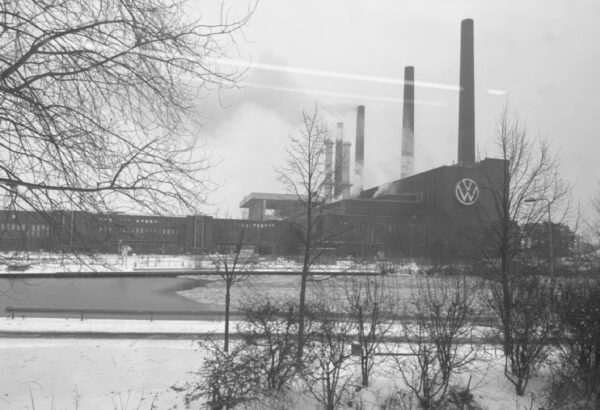
This is where the Volkswagen factory stands, a dot, just a dot on the trans-European route between Berlin and the cities of the West. The train stops in front of the brick monument, with its towering columns: a monument to a fossil age that has degraded everything, to a reign of the automobile that ultimately came to coincide with the disappointed promises of the sovereign individual. A factory that brings our train to a halt, a factory where we might imagine the remaining workers emerging, as in a Lumière brothers film.
Yes, there, on the other side of the frozen canal, a factory, as if to bear witness to what the European project has become: a desperate hope of carrying on producing and selling cars.
But the train starts moving again, and I must try to recover from this, from this collapse.
To recover my faith, to remain faithful to the dream of my younger years.
To say once again, and always, what Europe means to me: a home for exiles, for migrations, for multiple languages, which must transform countless feelings of guilt and threatening forms of pride into joy.
Yes, and this task, too, is the only one still worthy of being pursued.
To repair History…
Europe existed long before the EEC, long before the Union. Hugo celebrated it, as Zweig would do decades later.
And what mattered then, yes, was to champion ideas: a certain vision of rights, equality and justice. The abolition of slavery, the struggle against colonialism, the construction of a world governed by common rules.
A place of refuge from dictatorships.
But today, in the minds of those who gather in Davos, who bow before the kings of the “Council”, what is Europe if not a grand coalition of merchants and business leaders?
A perverted temple of production, still clinging to old dogmas that are disproved every day: trade will bring peace.
Adam Smith, and his invisible hand.
The fair allocation of resources through the free play of the market.
When all you have to do is step outside your front door to see that it is a “confidence trick”, that at every level of society, the dice are loaded.
And I, here on my train, keeping in my mind’s eye a snapshot of Wolfsburg station, of the Volkswagen factory, of the canal stretched out before me, now find myself thinking of a painting by Pieter Bruegel.
You know, that image in which little figures, happy little figures – or so we think at first – are skating on the ice. The sky is grey-white, and the ochre-brick houses stretch as far as the eye can see, covered in snow.
Everyone is happy, yes, happy; it looks like peace.
The plain in the painting, the plain outside, glimpsed through the train windows, beyond the Volkswagen factory… In the painting, Europe, but the countryside still alive, which we can almost feel resonating with the joyful cries of children.
This is before urbanisation, before the rural exodus, before industrialisation, before the mechanisation of agriculture, before pesticides, before the diseases associated with modern chemistry.
Bayer does not exist here, in this scene by Pieter Bruegel the Elder.
And I keep wondering, again and again, how this old faith in the idea of linear, uninterrupted Progress manages to persist, how it clings so stubbornly to life.
How do all these newly elected princes, this caste of believers, manage never to doubt the values of their Church?
Their God: capital, investment, technology…
The train speeds on and on, the landscapes slip past. I, too, am a passer-by, a trans-European traveller, a shadow in a world where writers are fading away, where books will soon be written by countless AIs, coldly connected to the minds of the past, to the vast mass of data, to the texts produced over the centuries.
I am disappearing, you are disappearing too, we are disappearing.
I have kept the memory of that painting by Bruegel the Elder, but it has now become entangled with another.
One that is housed—I have checked—in the English royal collections, in one of the palaces of the kings and queens of England.
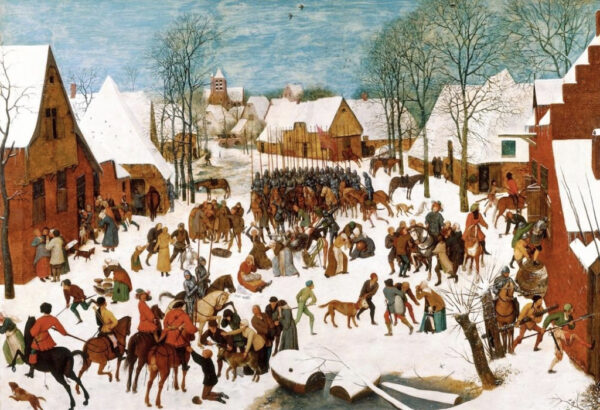
Bruegel again, returning to me whenever I see snow, here, as I travel across the northern plains. And here, as in the other painting, before the eye begins to pick out the details of what has been painted, there are these houses stretching as far as the eye can see, so typical of Flanders, the bare trees, the branches…
A vanishing point, marked by the height of the church, far, far away.
And this time, everything unfolds beneath a clear sky.
Yes, there is blue in the sky.
You know, you remember, these are the finest days of the northern winter, when it is cold and dry, when the snow has covered the world, giving us the fleeting feeling that everything will begin again.
Soon, yes, we tell ourselves, soon there will be a blank page on which we will write the history to come.
A different kind of history, a different kind of Europe.
But for now, this painting by Bruegel, there, you know the one, with the clear sky and the army approaching in the distance, it is a trap.
From afar, we believe it shows us peace, that we too will go skating on the frozen canal, before discovering that there is no canal here at all; and what is being shown to us, do you remember, is the Massacre of the Innocents, a blood-soaked day when newborn babies are slaughtered…
A painting I have always loved, but whose meaning has grown over the years, as though it were gradually revealing the true face of the world; or perhaps simply of this world, the one I am travelling through: Europe…
And the photograph I take is this one… the canal, then the factory… a summary of the Europe they wanted, the Europe they desired… the Europe they still wish to defend, an Europe of car dealers, of manufacturers…
Here, the W of Volkswagen, the people’s car; here, the memories of Europe, of manufactured war, of manufactured death… the canal, the ice, the memory of Bruegel’s painting, echoing what we see every day on television… the peace, the tranquillity of Europe, while images of destruction reach us from every direction. Here, around my train speeding towards Hanover, the snow, the expanses blanketed in snow, resting as they await spring, when nature alone, asking nothing in return, will bring forth life, make the seeds and fruits grow that will nourish us; but here, for the time being, these expanses might just as well be the deserted battlefields of Ukraine…
And then, travelling south from Hanover towards Frankfurt, the sky, so low, opened up, and the Earth began to undulate into clusters of settlements… at last, there were shapes… villages nestled in the hollows of the valleys…
The snow, the white, the sun…: