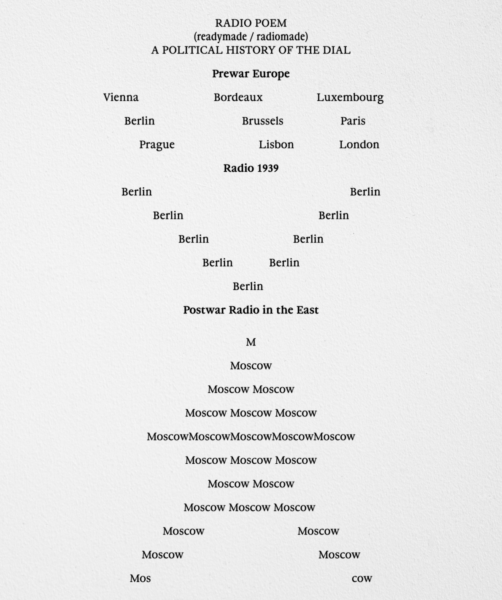
My first Europe was an old wooden radio from my childhood in the village. I remember how the cities glowed softly on the dial, arranged in rows:
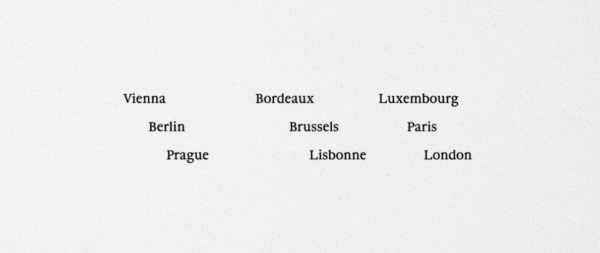
That was my first map of Europe—that’s how I imagined it. I stared at the blue eye of the tube radio and expected that when I turned the wooden knob and moved the dial to London, I would step right into the city through its sounds: horse-drawn carriages, old cars, light fog and rain, with a voice hoarse from Sherlock Holmes’s pipe.
Once, when I was left alone for a moment with the old radio, I set the dial to London and… nothing. I heard nothing. Just a faint crackling and static. Europe had fallen silent. Europe was gone. London didn’t exist. I tuned the dial to Paris—nothing there, either. Not the bells of Notre Dame, nor Gavroche and Cosette, nor the clanging of D’Artagnan’s sword and those of the three musketeers. Such were my notions of these places, cities conjured up from books.
My father’s Europe consisted of a newer transistor radio and a kitchen with a bolt on the door—we were living in the city by then. That was the bare minimum for Europe to appear—a transistor radio and a locked kitchen. And it had to be evening. And there had to be no one around, or at least the neighbor shouldn’t be eavesdropping. The transistor radio was usually a VEF or, even better, a Selena, because on one part of the shortwave band, with a lot of luck, you could catch snippets of another station: Radio Free Europe. That was the name of the station our fathers here were trying to tune in to. My father would lock himself in the kitchen, while I’d press my ear against the keyhole outside to try to make out some of those strange noises, fragmented words that barely reached us here.
Later I learned that the reason for this crackling was that Free Europe and other European stations were being jammed. This happened mainly on shortwave; these broadcasts were the primary target of state-sponsored jamming during the Cold War. Huge transmitters were built that broadcast a hum, a whine, noise, or music on the same frequencies as “enemy stations.” A jammed-out Europe.
My grandfather’s Europe was the most real. He was the lucky one. “Born lucky,” my grandmother would say, secretly envying him for having “traveled half the world”—half the world meaning Serbia and Hungary during World War II. A very lucky man indeed. His Europe was an old gramophone with a horn that he had listened to in a Hungarian house between battles. People listened to music on a gramophone with a horn and drank tea from glass cups—that was something he would never forget. My grandfather never managed to buy a gramophone; in other words, his dream of Europe remained unfulfilled, as is often the case with true dreams. But every evening, when we sat down at the table, he would recite—like a strange prayer—the twelve Hungarian words he had brought back from the front. Ordinary words: bread, water, wine, glass, house, horse, thank you. Among them was the word “beautiful,” which made my grandmother very jealous. Why would a soldier need to know a word like that?
That was my grandfather’s Europe—a house with a gramophone and twelve Hungarian words brought back from the front. (Incidentally, the radio was the primary medium of World War II. The number of radio owners skyrocketed on the eve of the war.)
So each of the three of us had our own dreamed-of—and unattainable—Europe. A Europe that I imagined through the static of that old radio and all the books in our library… A Europe that I managed to visit for the first time when I was 21. The Wall had fallen, and I gazed at it eagerly, with all the pent-up and unfulfilled longing of my childhood and adolescence. A Europe that my father imagined as a place of freedom. A Europe, which for my grandfather had been a gramophone with a horn and music. A Europe, which—for lack of another war—did not invite him to visit again. Our personal, biographical, dreamt-of, and… denied Europe.
I want to say a few words about this Europe that was denied to us—not just through the radio. Leaving Bulgaria and traveling to the West during the communist era was impossible for at least two or three generations. My mother and father never saw Rome or Paris. That part of the continent was closed off to us—or rather, we were closed off from it—and that was a rather oppressive feeling. Montaigne says at one point: “I have no particular desire to visit India, but if someone were to forbid me from going there, I would be the unhappiest person on earth.” I discovered this quote in one of the essays by the Bulgarian writer Georgi Markov, himself an exile who was murdered by the communist secret services in London in 1978—an assassination that has gone down in history as “The Bulgarian Umbrella Murder.”
As the child of parents who were unable to leave the country, I began traveling everywhere I could once the world opened up to us. I traveled most often in the wake of my books, and for a long time I never turned down an invitation. It was as if, through my excessive traveling, I were compensating for the trips my loved ones were denied.
My father never saw Paris, as I mentioned above, but until the very end he imagined it in his mind; he knew—from movies, chansons, and books—all the boulevards and museums. On my first trip there in 2000, I called him and said, “You know, I was on the Champs-Élysées yesterday—just a huge boulevard, nothing special.” Secretly, I’d wanted to say that he had nothing to regret, but he was offended and almost scolded me for speaking that way. His unvisited, dreamt-of Paris was far more beautiful than mine. And that’s how it would remain.
Which is why now, when I travel, when I step into the world once denied to us, I see it through the eyes of several generations of loved ones who never traveled. Some of them are no longer with us, so I have to collect stories, because one day they’ll want me to tell them.
Our parents never left their villages and towns, but they imagined and dreamed of Europe. We can travel wherever we want, but it’s as if we’ve lost the dream of Europe. “Myth is the nothing that is everything,” says Pessoa. Europe is impossible without the “nothing” of myth, without the reimagining of our desire for it, without at least a little passion. A lack of a future is more severe than a lack of financial resources. The depletion of reserves of meaning is more frightening than the depletion of oil reserves. Losing the dream of Europe is more irreparable than inflation. Or, at the very least, all of this is connected.
I find it particularly important that we continue to dream of Europe, that we not give up on the legend—or if you will—the myth of it, its layers of culture. All of its artists, musicians, writers, and philosophers have, over the centuries, created reserves of meaning. In any case, Europe has no more enduring assets than its culture and meaning.
And it is precisely this sense of meaning that we will need more and more in troubled times like these. That is why Europe is our natural refuge.
Let us recall that the Phoenician princess Europa herself came from the periphery of the continent. To a great extent, European democracy, philosophy, science, medicine, and theater were born not in the center of the continent, but in its ancient Greek civilization. Which is why the peripheries should not be underestimated. Every so-called periphery is a center in its own way. And in a world like today’s, marked by wars and conflicts, “center” is a very fluid concept, one that usually stems from the source of pain. Today, the world—including Europe—has many points of pain. And we, who come from the once-silenced places in Europe, of banned radio stations and denied worlds, can feel it in our bones when new dictatorships are looming.
When meaning is exhausted, the future is bleak, and the present is no longer a safe haven for us, dictatorships take root easily. And they offer us a deceptive refuge in the past. This is what my novel Time Shelter is about. In it, Gaustine begins building “clinics of the past,” where you can take refuge on floors representing the 1960s, 1970s, or 1980s. At first, it is a place only for those suffering from dementia and Alzheimer’s, but gradually it also becomes a refuge for healthy people seeking escape from the present. Entire cities and countries are turning into “clinics of the past.” Populists sense this pull toward the past and propose “referendums on the past”—in Italy, France, Bulgaria, and throughout Europe. You vote to go back to the time when you believe you were historically great. The past is gradually turning into propaganda.
It’s interesting how ideology reverses the flow of time, using the past and the future as it sees fit. I remember firsthand how, as children during the communist era, we were promised a bright future. The future was that Ithaca that awaited us, where everything would run like clockwork. There, in the communism of the future, everyone would have everything they desired. I remember wishing for a real soccer ball, which my parents couldn’t afford. Communism, however, was delayed, and I never got it. Today, in contrast to communism, the new populist ideologies promise us a bright past. Perhaps this is because the future has run its course, while the resources of the past are always available. This return is particularly suitable for the new nationalisms, because they feed primarily on the past—a fabricated, often concocted past—from which they draw their vitality and strength. Vampires of the past, so to speak. In this sense, even our wars of today are wars over the past. Russia’s war against Ukraine is, par excellence, Putin’s war to redistribute the resources of the past. An attempt to take everyone back to those years of World War II and the Soviet Union.
But let’s return to the radio. In the 1930s, during its heyday, given its functionality—transcending borders and distances, instantly connecting people from different parts of the world, mass dissemination, and so on—the radio joyfully sparked new ideas and amplified existing ones. Ideas of a new unity among nations, brotherhood, and the abolition of national borders.
Listening to the radio is part of an intense exchange with the world. It is a medium that broadcasts continuously, and at any given moment, the world can be sought out and found on a particular radio frequency. According to the media researcher Elihu Katz, radio has three distinctive qualities that define its powerful impact: it is total, immediate, and direct.
Of course, new ideologies were quick to take advantage of these qualities during that very same decade. Political events transformed radio—which until then had been mostly “musical”—into a primary medium for information (and propaganda). The war literally shifted the priorities of radio programming. From 1939 onward, the proportion of “talk shows” increased significantly; news bulletins and commentary-propaganda segments became more frequent, while the relative share of music decreased. Radio ownership rose sharply during the war years. Censorship also intensified—radio sets were sealed, and the range of the radio dial was restricted in the most literal sense. All of this continued in Eastern Europe during the Cold War years. In fact, this is what all totalitarian systems do—they limit one’s presence in the world. They cut off the world and Europe.
Here, I’d like to mention—at least as a curiosity—the white plastic “radio point” from the 1970s and 1980s in Bulgaria. It hung on the wall of every institution and every Bulgarian home, most often in the kitchen. The single knob on it served solely to turn the volume up or down. There was only one station, which was impossible to change. The Bulgarian state radio program played continuously, interrupted at times to broadcast regional announcements, messages from local authorities, a bit of propaganda, or notices about a meeting or demonstration. The radio point was more of a loudspeaker than a radio. And in this way, it became the perfect metaphor for the system. The station—like the system itself—is unique, eternal, and immutable.
The new history of Europe can be told through radio. Radio as a memory of the Europes that were denied to us. I’m including as a postscript to this text a short, readymade radio poem that presents the political history of the radio dial.
Translated from Bulgarian by Angela Rodel.