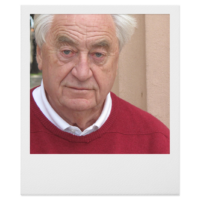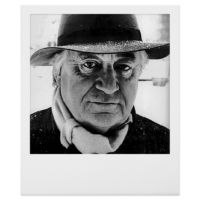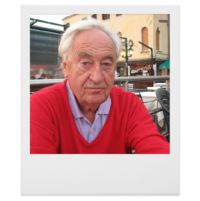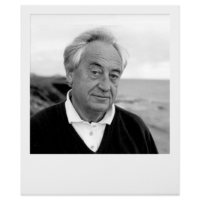
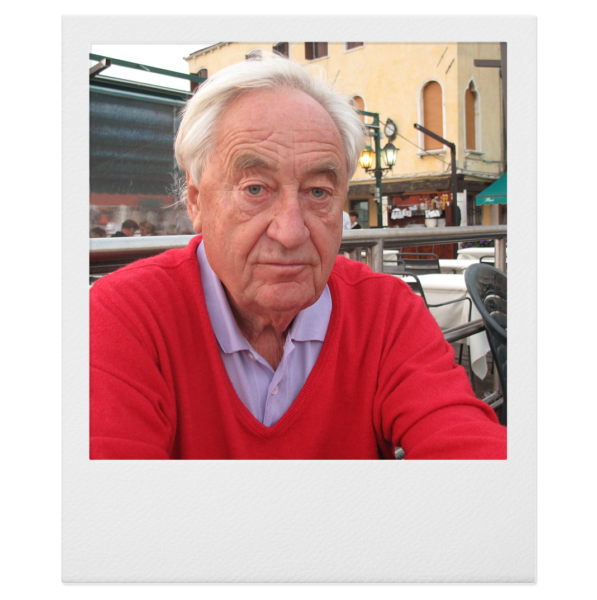
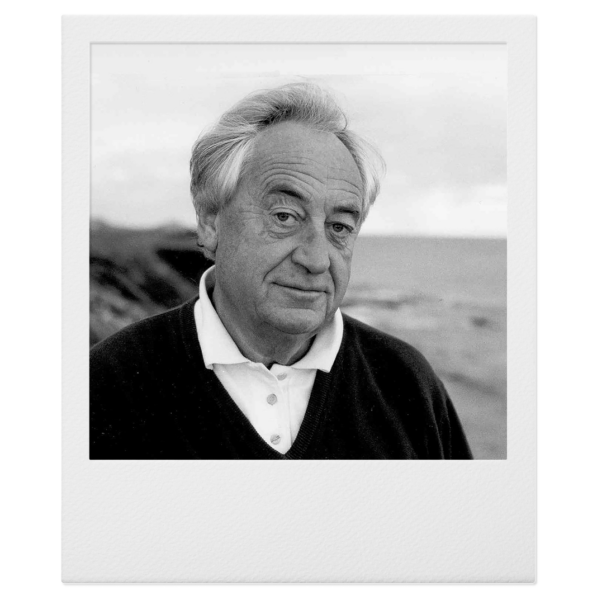

On the Life and Work of Cees Nooteboom
“Never stopped walking” – these are the closing words of a poem in Nooteboom’s collection Light Everywhere (Licht overal, 2012). He was nineteen when, in 1953, he said goodbye to his office job at the Rotterdam Bank and set off to explore the world by hitchhiking. Without luggage and with hardly any money. He opened the door to freedom. He never stopped walking after that, nor did he ever stop reading and writing. These became the very core of his life.
As a young man, Nooteboom hitchhiked through France, Spain and the rest of Europe. There was, he said, no better way to become a convinced European than to be constantly on the move, travelling with Germans, French, English, Swedes, Poles and others. Two years later, he made his literary debut with Philip and the Others (Philip en de anderen, 1954), a dreamy, mysterious novel inspired by a French girl he had met while hitchhiking.
One day, you begin, and you write, he once explained, a few hundred words every day. After that, in a sense, things took care of themselves. Of course, to write, you needed knowledge: you had to read, travel and observe. His debut marked the beginning of what would become an unparalleled body of work. He wrote countless travelogues, poems, novels and essays. Over the years, he received dozens of international awards for his work, from the Dutch P.C. Hooft Prize to the Austrian State Prize, and from the German Goethe Prize to Spain’s Premio Formentor.
When someone asked him how he had become a writer, he would repeat the question with a sigh. How does someone become a writer? His parents moved house frequently and eventually divorced; his father disappeared from his life, and he grew up in foster families and at boarding schools and residential schools run by monks. From the Franciscans and the Augustinians, he learned Greek and Latin, the classical languages that lie at the foundation of European history. He was, he said, “eternally grateful” to them.
When Nooteboom received an honorary doctorate from University College London in 2019, in recognition of his exceptional contribution to European literature, he was dressed in a magnificent gown of shimmering golden-brown and purple fabric, complete with a velvet cap. During the graduation ceremony, the students filed past him for three hours to receive their degrees. At the end of the ceremony, Nooteboom had to kneel on a small bench upholstered in red velvet, where he received a full-fledged knighthood-style dubbing with a sword. He thought it was wonderful.
In his acceptance speech, he spoke about the first notebook he had ever bought, back when he was nineteen. He had once asked his friend, the German writer Rüdiger Safranski, when on earth he had found the time to write all his biographies of Goethe and Schiller. Safranski had replied that he had written them “while Nooteboom was reading the world.”
With his novel Rituals (Rituelen, 1980), a philosophical and psychological exploration of how to live, Nooteboom achieved a major breakthrough with the reading public. The book contains a line that is often quoted: “Memory is like a dog that lies down wherever it pleases.” A good memory? No, that was not something he had. He remembered virtually nothing of the first six years of his life. He sometimes called them “a completed period of oblivion”. A pity, because childhood is every writer’s treasure chest.
He did, however, remember the deafening roar of anti-aircraft guns when, on 10 May 1940, the Germans attacked the military airfield at Ypenburg, near where his family lived. His father, who would later die in the bombing of Bezuidenhout, had placed an armchair on the balcony so that he could watch. Nooteboom, then six years old, had been terrified. Small wonder, then, that the war so often casts its shadow across his work.
Nooteboom remembered what other people forgot, and forgot what other people remembered. He looked, he observed, noticing details, gestures and eyes – on terraces, in the street and throughout his many travels. But dates, years – no, those did not stay with him. That was the task of his wife and life partner, the photographer Simone Sassen.
Nooteboom was often right where history was unfolding in Europe. This helped make him a European in heart and soul. Spain was his greatest love, the country he probably wrote about more than any other. Roads to Santiago (De omweg naar Santiago,1992), for example, bears witness to his many journeys through Spain and to his profound knowledge of the country. He understood the things that were said and written about dictatorship, censorship and exile. He loved Spanish culture and the landscape. Spain had given him an enormous storehouse of memories: “The colour that, after all these years and journeys, I still associate with Spain is brown: the meagre, bleached-out brown of the meseta, the Spanish plateau, austere and sparse, a landscape that, rightly or wrongly, expresses for me the essence of the Spanish character. It is what you see when flying from Amsterdam to Madrid. First comes the pale, native green of the Dutch polders, land reclaimed from the sea; then the darker green of France, still rich in forests; next, the great dividing wall of the mountains, accentuated by the high white snow lying on their peaks; and then, soon enough, the colours of the Spanish earth, in which the first desert tones begin to appear, the sandy hues showing through the plants that, in a true desert, would not be there at all.”[1]
Reading Nooteboom also means constantly travelling with him to other places, other continents, other eras. In 1956, he was in Budapest during the uprising. A year later, he sailed as a seaman to the Caribbean and South America, witnessing the traces left by colonialism. In Paris and Prague, he observed the events of May 1968. In 1989, when the Berlin Wall fell, he was in Berlin. There he wrote his celebrated novel All Souls’ Day(Allerzielen, 1998), a love story in which the lives of its characters are interwoven with history. Bolivia, Brazil, Niger, Mali, Gambia, Malaysia, Iran, Mexico, Japan — there is hardly a country he did not visit and write about. His Gesammelte Werke (Collected Works), comprising more than ten volumes, have been published by the German publishing house Suhrkamp.
Nooteboom made dozens of journeys with the photographer Eddy Posthuma de Boer during the 1960s, 1970s and 1980s. Later, he travelled mainly with his wife, the photographer Simone Sassen. Together they created Tumbas, a beautiful book about the graves of poets and thinkers, and Saigoku, a visual and literary account of their pilgrimage to the thirty-three temples near Kyoto.
Nooteboom had a gift for capturing a person or a thing in just a few words. He looked, then distilled the essence of what he saw. His style is musical and elegant, sometimes melancholic, often witty and incisive. Time, memory and transience are recurring themes. One example is the magnificent essay Venice: The Lion, the City and the Water (Venetië. De leeuw, de stad en het water, 2018). Nooteboom travelled to Venice countless times. Each time, he stayed somewhere different and visited both new and familiar churches, alleyways and cemeteries: “Everything is an exercise in repetition; the city must be conquered anew each time. (…) How wonderful it would be to approach Venice for the first time once again, but this time stealthily, sailing towards the labyrinth through the other labyrinth of the marshes, among the aquatic creatures, in the first morning mist on a January day like today, with nothing but the sound of the birds and the splash of the oars, the brackish water still and gleaming, the vision in the distance still shrouded, the city wrapped in its own mystery.”[2]
The photograph by Simone Sassen – waving seaweed just beneath the water’s surface – reproduced on the facing page completes the beauty evoked by these sentences. The book can be read as a self-portrait of a writer who offers us a glimpse into his life and his inner world. Nooteboom takes us to the city he first visited more than fifty years ago. Venice overwhelmed him, fascinated him and seduced him, and he was captivated by it for the rest of his life.
Throughout his work, dozens of other lives come into view: those of men and women, of writers and artists from bygone eras, of characters from books and figures depicted in paintings. He often wrote essays about the painters he admired. For him, “the present of the eleventh century was just as fascinating as the present of today.”[3]
“Works of art are time machines,” he often said. And so he made comparisons, setting bygone eras alongside the present: “Can a Spaniard today still recognise himself in Zurbarán’s monks, in a portrait of the mystic Teresa of Ávila? Or, to put it quite differently, and in terms of the past, why do I see similarities between Zurbarán’s inspired portrait of Saint Serapion and the Threatened Swan painted thirty years later by Jan Asselijn?” Nooteboom, as it were, immerses himself in the painting. He wants to know more about the life it depicts, to become part of it himself. His literary references are personal, and international.
Although Nooteboom is often regarded as the maestro of literary travel writing[4], he was also a magnificent poet. His very first collection, published in 1955, was entitled The Dead Seek a House. He was twenty-two years old. Death would remain a theme in his poetry throughout his life. “You never know exactly where that comes from — the war, my father’s death?”[5] Images of war also appear in one of his final collections, entitled Leaving: A Poem from the Time of the Virus (Afscheid: gedicht uit de tijd van het virus, 2020).
Everyone out! Among them the girl
in the door opening, last glance at the world,
a platform with a man in grey,
a tree in the distance
sees everything.
The girl is being deported to a concentration camp, Nooteboom explained. “Everyone knows those horrific images of people in concentration camps, their heads shaved. Before they were taken away, these people – doctors, lawyers – had dressed themselves neatly, with hats and ties. Those are things that have never left me. I have seen what can happen to a society in the shortest possible time. An utter abyss.”
Nooteboom spent only a few weeks each year in Amsterdam. His relationship with his homeland was one of love and hate. While the world embraced him and showered him with awards, he rarely felt that he was properly appreciated in the country where he was born. Only occasionally was he satisfied with the attention he received from literary critics at home. Yet, despite having been born in The Hague and spending much of every year travelling abroad throughout his life, he considered himself “irrevocably an Amsterdammer”. After a few weeks in the Dutch capital, however, the familiar restlessness would return, and he would want to leave.
Throughout his life, he was repeatedly asked about his extensive travels. Was he running away? Was it restlessness? In his younger years, travelling had been an intensely euphoric experience: “You would set off again, rubbing your hands with excitement.” Much of that euphoria came from the exclusivity of travel in those days. “We were the ones who travelled. Others didn’t. That feeling was very strong.”[6]
Later, he often described travel as “a certain form of loneliness that you seek out yourself”, a form of “intensified living”. Everything became sharper. In his words, travel became “a concentrated form of writing”, and even “a form of meditation”, a way of thinking. But it was also a confrontation with himself. Small wonder that one of Nooteboom’s best-known sayings was: “I could have had a thousand lives, but I took only one!”[7]
Many of his early stories and reports appeared in the daily newspaper Het Parool, the weekly magazine Elsevier or the magazine Avenue. For this latter publication, Nooteboom also translated works by authors he had met on his many travels. He was a constant and voracious reader of both contemporary writers and the classics. Throughout his life, he generously recommended young writers to publishers abroad.
Nooteboom’s own work was translated into more than thirty languages. He held his close friend Philippe Noble, who translated almost his entire body of work into French and more recently edited his diaries[8] in the highest regard. Nooteboom took a keen interest in how his work was translated and published, and attended gatherings where he could meet his translators. He valued them enormously and understood that he owed much of his international reputation to their dedication.
Every summer, Nooteboom and his wife spent time on their beloved island of Menorca. We gain a sense of his love for his Mediterranean garden, among other places, from 533: A Book of Days (533. Een dagenboek, 2016). His cacti appear on the very first page: “The flowers of cacti are incomparable to any other flowers. They look as though they have achieved a victory and, strangely enough, as though they would prefer to get married today, though it is not clear to whom.”[9]
At the far end of that garden, where his studio stood, he wrote a large part of his life’s work, looking out onto a wall of flat stones. On the other side, a donkey would bray for a carrot.
Nooteboom could tell anecdote after anecdote, about his travels and his international circle of writer friends. He spoke in circles, spirals and pirouettes. As a writer, he disliked the first-person form. In his travel writing, he did write about himself, but, as he put it, “my inner life — not for all the gold in the world! When someone asks me whom I would like to have as my biographer, I say: no one! It’s all such frivolous nonsense.”[10]
A curious and meticulous observer of the world – that is what Nooteboom was, above all. Whether it was a person, a place, a painting, a statue or a garden, he was always eager to discover the story behind it. That was the driving force behind his unique gift as a writer.
[1]Rembrandt-Velázques. Nederlandse en Spaanse meesters. With a text by Cees Nooteboom. Rijksmuseum, 2019
[2] Margot Dijkgraaf, Schrijven in cirkels: een interview met Cees Nooteboom. De Nederlandse Boekengids, 2019
[3] Piet Piryns, Met lopen nooit meer opgehouden. In gesprek met Cees Nooteboom. De Bezige Bij, 2013
[4] Margot Dijkgraaf, De maestro van het literaire reisverhaal is gestorven, NRC, 12 februari 2026
[5] Margot Dijkgraaf, Ik heb gezien wat er met een maatschappij kan gebeuren. NRC, 11 juni 2020
[6] Margot Dijkgraaf, Nooteboom en de anderen. De Bezige Bij, 2009
[7] Schrijversprentenboek, Atlas Contact en Letterkundig Museum, 1997
[8] Cees Nooteboom, De danser en de monnik. Dagboeken 1970-1995 en Naar de wereld, in de wereld, uit de wereld. Dagboeken 1996-2006, beide bezorgd door Philippe Noble en uitgegeven door Koppernik
[9] Cees Nooteboom, 533. Een dagenboek. De Bezige Bij, 2016
[10] Margot Dijkgraaf, Schrijven in cirkels: een interview met Cees Nooteboom. De Nederlandse Boekengids, 2019