
The Second Life of Arvo Pärt’s Music in Cinema
The music of Arvo Pärt, the most performed living composer in concert halls around the world¹, reaches global audiences not only through live performances, recordings, radio and music platforms. Even if his music is performed, on average, at three concerts every single day of the year, it is nevertheless quite possible that a very large proportion of audiences worldwide have first encountered Pärt’s music – often without even realising it – through film or television, where it can be heard in hundreds, if not thousands, of audiovisual works².
We do not actually know the exact number, since Pärt’s music appears not only in major feature films listed in the vast IMDb database, but also in hundreds of short films and student productions. The Arvo Pärt Centre, which has become the permanent home of the composer’s creative legacy in Laulasmaa and is dedicated to making his work and heritage known to wider audiences, has organised annual film screenings since 2011, presenting films that feature the maestro’s music³.
In curating this film programme, I have been particularly intrigued by the question of why such a diverse range of filmmakers keep returning to this particular music – and what happens to a film the moment Pärt’s music enters it?
Our programmes have included films by such well-known directors as Gus Van Sant, Tom Tykwer, Mike Nichols, Tengiz Abuladze, Andrei Zvyagintsev, Bernardo Bertolucci, Paolo Sorrentino, Werner Herzog, Jean-Luc Godard and Carlos Reygadas, alongside works by lesser-known filmmakers. A separate chapter is devoted to films made in Soviet Estonia featuring music Pärt himself composed specifically for the screen, as well as films portraying the composer. Viewed side by side and retrospectively, these films begin to reveal a pattern that is perhaps somewhat different from the conventional image of Pärt as a composer of silence, sacredness and transcendence. The following essay can therefore be read as a reflection and a summary of what I have discovered through my curatorial work so far.
The invisibile power of film music
Film music is often thought of as an invisible force that guides the viewer towards a particular emotion at precisely the right moment: fear, hope, joy or grief. In cinema, however, Arvo Pärt’s music often behaves in a rather unexpected way – as an interruption of the existing situation. A character or event seems to come to a standstill, the landscape opens up, everyday sounds recede, and different kind of time emerges on the screen: not the time in which the event takes place, but time in which its meaning is only beginning to become apparent.
While putting together the programmes for the Arvo Pärt Centre’s film screenings, I have repeatedly come across films in which his music appears at moments when a person’s previous relationship with the world has been ruptured: following death, violence, straying, departure, loss of faith, historical catastrophe or the disintegration of memory. The music does not restore the previous order, nor does it necessarily explain what has happened. Instead, it creates a different kind of duration – a time in which the image can become visible once again after the Great Event has already taken place, although now in a slightly different way. Neither grief alone nor sacredness alone adequately describes this phenomenon. The cinematic life of Pärt’s music more often begins at the moment when existing explanations simply cease to work and the filmmaker needs something to bring that rupture into sharper focus.
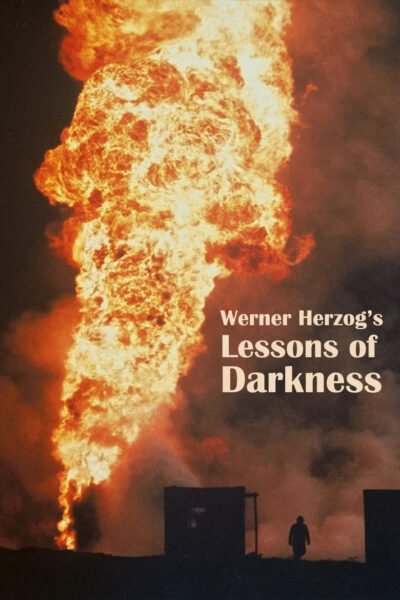
Consider, for example, Werner Herzog’s Lessons of Darkness (1992), filmed in the aftermath of the Gulf War. The catastrophe has already happened, and the camera moves across a burning landscape as if travelling through a world after the end of the world. In the first third of the film, Herzog sets Pärt’s nearly five-minute Stabat Mater against aerial footage of Kuwait’s burning oil fields, accompanying the images with an apocalyptic passage from Chapter 16 of the Book of Revelation. Together, these elements create an extraordinarily dreamlike and ethereal cinematic experience.
A similar approach can be found in Alice Winocour’s Revoir Paris (2022), in which the protagonist survives a terrorist attack in a Paris restaurant. Physically, she survives, but her memories of the event are fragmented. The film is less concerned with reconstructing the terrorist attack itself than with exploring a person’s ability to learn to trust the world again. Pärt’s Fratres frames the beginning and the end of the film. Here, the music does not describe the catastrophe, but rather the time that follows it – a state in which a person attempts to reassemble a whole from the fragments of their life.
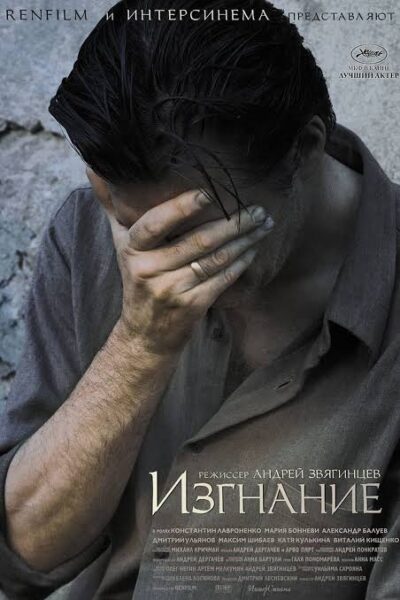
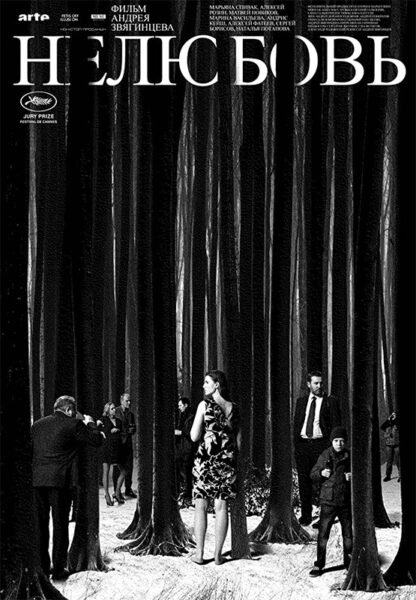
This after-time recurs frequently in the cinematic use of Pärt’s music. In Mike Nichols’s Wit (2001), the protagonist confronts cancer and her own mortality. In Tengiz Abuladze’s Repentance (1984), the totalitarian past intrudes upon the present because it cannot simply be buried. In Christian Frei’s War Photographer (2001), the question is how to look at the suffering of others without turning it into something to be consumed. In Andrei Zvyagintsev’s The Banishment (2007) and Loveless (2017), we encounter a shattered family world in which decisions can no longer be undone.
Pärt’s music does not necessarily sound at the most dramatic moment of these films. Often, it enters when the drama, in the conventional sense, is already over, bringing us to the question: what now? How do we go on?
This may be one reason why Pärt’s music works so well in film endings, epilogues, extended landscape shots and closing credits. It does not merely dramatise what happens; it creates space for what remains after it has happened.
Another duration
Kaire Maimets-Volt, one of the most thorough researchers of Pärt’s music in film, has described the ability of the tintinnabuli music to open up what might be called a “higher realm of values” within a film – a level from which the characters’ actions begin to appear in a different light. What matters here is that meaning does not exist in a ready-made form either in the music or in the image. It emerges through their encounter⁴.
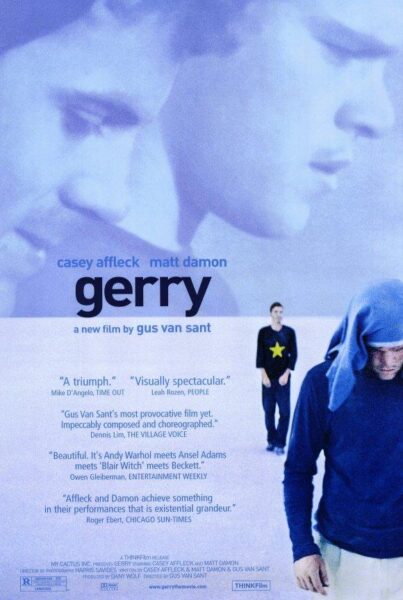
The first programme of the Arvo Pärt Centre’s film screenings, in 2011, was curated by Kaire herself and consisted of three films: Wit, Tom Tykwer’s Heaven and Gus Van Sant’s Gerry. In retrospect, they form an almost perfect triangle for understanding the subsequent interpretations of Pärt’s music in cinema. In Wit, music meets mortality and the body. In Heaven, moral ambiguity, love and the possibility of redemption. In Gerry, time, landscape and emptiness.
Gerry in particular demonstrates why it would be misleading to equate Pärt’s music simply with slowness or solemnity. In Van Sant’s film, two men get lost in the desert. The narrative becomes almost non-existent, and landscape and duration themselves become the film’s real events. Für Alina offers no explanation of this world. Rather, it somehow makes perceptible the repetitive flow of time unfolding in boredom.
Brent Yorgason’s corpus study of Pärt’s music in film confirms that works such as Für Alina, Fratres, Spiegel im Spiegel and Cantus in Memory of Benjamin Britten frequently appear at moments when external action recedes and attention shifts towards inner reflection⁵. Yet watching these films together allows us to go a step further. Pärt’s music does not merely create introspection. It can alter the viewer’s temporal position in relation to the film. Cinema normally moves in one direction: one event leads to the next. Pärt’s music can momentarily suspend this causality. Another kind of duration emerges, in which the question is no longer “What happens next?” but rather “What does what has already happened mean?”
Looking without condemning or absolving
This becomes particularly evident in Andrei Zvyagintsev’s films. In The Banishment, Für Alina appears in a story whose picturesque, almost pastoral and idyllic aesthetic conceals jealousy, distrust and irreversible decisions. At the end of the film, the Memento section of Kanon pokajanen can be heard. In the urban world of Loveless, where the relationship between the parents has deteriorated into almost irreconcilable hostility and their child disappears, we hear Silouan’s Song, an instrumental work for string orchestra. The piece also carries a revealing subtitle: “My soul yearns after the Lord…”, referring to the yearning, devotional text of the monk Silouan. Yet this is presumably knowledge available to the director but not to the film’s audience, who hear only the sounds of the string orchestra. In Zvyagintsev’s films, Pärt’s music does not redeem the characters. It does not suggest that their suffering makes them better people, nor does it absolve them of responsibility. Instead, the music creates a peculiar moral distance between them and the viewer: it becomes possible to look at a person more attentively, almost under a magnifying glass, without either condemning or absolving them.
This ties in well with Maria Cizmic’s research, in which she has described the role of Pärt’s tintinnabuli music in film primarily through the lens of empathy. In her account, it has become one of the means through which international film culture draws attention to the human consequences of violence⁶. But empathy need not mean identification. Pärt’s music can give an inner dimension even to a morally ambiguous or culpable character.
This is an important shift that Arvo Pärt’s music brings to cinema. The dramaturgical structure and temporal compression of film often compel viewers to decide quickly whose side to take. Pärt’s music can postpone that decision.
The image after the catastrophe
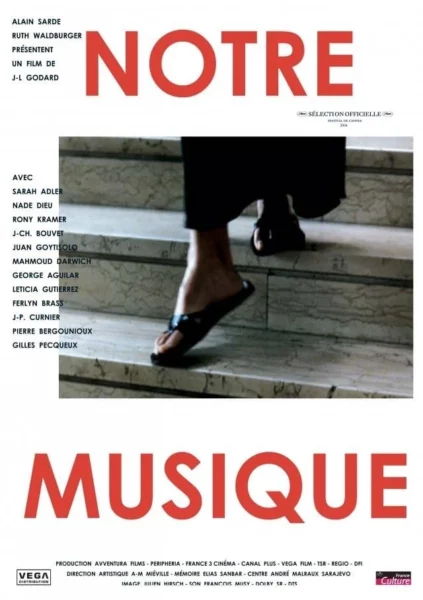
In the case of Jean-Luc Godard, the question of empathy becomes political and philosophical. Godard used Pärt’s music repeatedly. In Notre Musique (Our Music, 2004), screened as part of our film programme, the subject, despite the film’s title, is not music but rather war, memory and the ethics of representation. Divided, following Dante’s Divine Comedy, into Hell, Purgatory and Paradise, the film asks what images do with violence. Does representation help us remember, or does it turn suffering into just another image among many? In the final section of the film, Silouan’s Song can be heard. In Godard’s work, the calm ending accompanied by Pärt’s music stands in contrast to the violent torrent of images at the beginning. Whilst the editing juxtaposes images of wars and disasters, Pärt’s music allows the state of mind to linger.
A similar question arises in several documentaries. In Herzog’s Lessons of Darkness, Christian Frei’s War Photographer, The Giant Buddhas and Michael Madsen’s Into Eternity, the camera observes something that exceeds the ordinary sensory experience of an individual: war, destruction, the almost unimaginable temporal duration of nuclear waste or the destruction of cultural memory.
Pärt’s music does not in any way render these phenomena religious. Rather, it deepens the act of looking and opens up new questions. What does it mean to look at ruins? What does it mean to look at a war photograph? How can one depict something whose consequences will outlast any person currently alive?
Time greater than human being
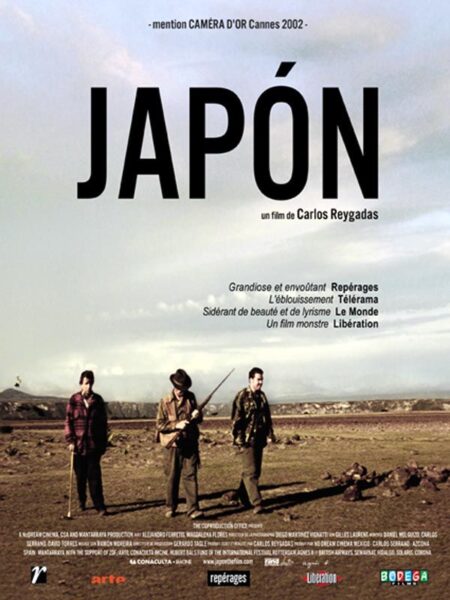
From here, another important dimension of Pärt’s music in film emerges: the placing of human biographical time within a much larger temporal scale. Reha Erdem’s Times and Winds, Jennifer Peedom’s Mountain, Van Sant’s Gerry, Herzog’s Lessons of Darkness and Carlos Reygadas’s Japón are very different films, but in all of them Pärt’s music transforms the landscape into something more than a mere setting for the action.
In Japón, an unnamed man leaves Mexico City for a remote mountain village, intending to take his own life. The film’s documentary-like portrayal of everyday life, its amateur actors, raw physicality and, at the same time, its monumental landscape do not in any way form a harmonious whole. Reygadas allows the natural soundscape to dominate much of the film. Only towards the very end, over a long shot of a railway line, does Cantus in Memory of Benjamin Britten unfold over several minutes. Here, the landscape is not an illustration of the protagonist’s inner world. On the contrary, the music creates a sense of displacement in which an ordinary human being is placed within a sublime world that existed before him and will continue long after him.
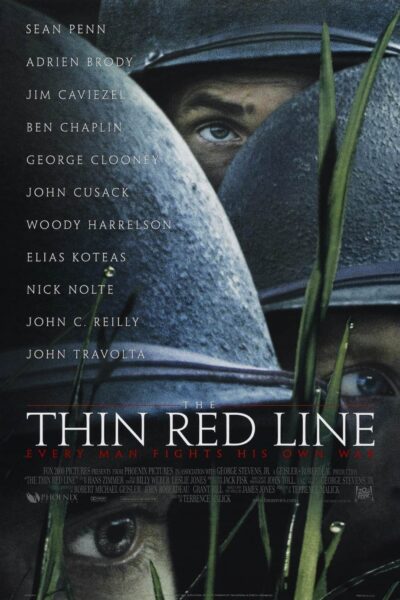
Terrence Malick also fits into this context, having featured Pärt’s music in five of his films. In one of his best-known works, The Thin Red Line, Pärt’s Annum per annum forms part of the film’s broader poetics, in which brutal war, nature, inner monologue and metaphysical questions coexist. In Malick’s films, nature is not simply the backdrop to human drama. Human violence takes place in a world that cannot be contained within human moral categories.
Godard, Zvyagintsev, Reygadas and Malick therefore use Pärt’s music in quite different ways. Godard explores the ethics of images and history. Zvyagintsev creates a space between guilt, responsibility and compassion. Reygadas and Malick place the human being within a temporal and cosmic scale far greater than themselves.
What unites them is less the composer’s particular religious affiliation or “spirituality” than their trust in Arvo Pärt’s music at moments when verbal and visual explanations are no longer sufficient.
The sacred without religion?
In international reception, Pärt’s music has acquired the label of “holy minimalism”. This is understandable to a certain extent, but it is nonetheless a somewhat problematic oversimplification. Pärt’s own religious worldview is certainly specific, whilst film culture often uses his music as a symbol of a much more general spirituality.
Indeed, his music frequently appears in explicitly Catholic contexts, as in Xavier Giannoli’s The Apparition, Maggie Betts’s Novitiate, Nanni Moretti’s We Have a Pope and Pablo Larraín’s The Club, all of which approach religion through the themes of institution, vocation, doubt, miracles and personal crisis. Bernardo Bertolucci’s Little Buddha (1993), however, introduces a very different religious tradition. The film is also noteworthy for being the first major Hollywood production to feature Arvo Pärt’s music. Although its principal composer was the Japanese master Ryuichi Sakamoto, Pärt’s relatively rarely performed work appears in one of the film’s most profound and symbolically charged sequences. The minimalist drum solo in Sarah Was Ninety Years Old accompanies the death meditation of Lama Norbu.
The cinematic “sacredness” of Pärt’s music has therefore transcended religious and confessional boundaries from the very beginning. It may signify Christian prayer, but just as readily death, memory, hope, love, or simply a moment when everyday time is interrupted, regardless of one’s religious perspective.
There is a danger here, too. Once a culture has learned to automatically associate Pärt’s sound with depth, purity and spirituality, his music can become a ready-made sign – an instruction to the viewer that this is an important moment. I was reminded of this during a conversation with the renowned Finnish filmmaker Pirjo Honkasalo, when I asked whether she had ever used Pärt’s music in her films. Her frank reply took me by surprise: “I have not used Arvo Pärt’s music in any of my films. Maybe because there is a saying among filmmakers that put Arvo Pärt on your soundtrack and any crap film works. I have tried to make my films work without that effect.”
When depth becomes a shortcut
The strong recognisability of Pärt’s music is both the reason for its cinematic success and a potential problem. In such a situation, there is a danger known as instant profundity: Pärt’s music may become a quick way of lending a scene prestige or metaphysical weight.
Consider, for example, Paolo Sorrentino, a master at making skilful use of musical shortcuts. In his major work La grande bellezza (The Great Beauty, 2013), Pärt’s music finds itself in an aesthetic universe that is almost its own opposite. Sorrentino’s Rome is baroquely opulent, thumping, boisterous and physical, full of parties and the grotesque. My Heart’s in the Highlands opens up another space within this excess. In Robert Burns’s poem, the voice longs for a faraway place. In Sorrentino’s film, this longing becomes a yearning for something that even all the visible beauty in the world cannot provide. The yearning structure of Pärt’s My Heart’s in the Highlands corresponds perfectly to the central question of the film: how can a person live amidst such great beauty and yet feel that their real life lies somewhere else?
In Sorrentino’s recurring use of Pärt, spectacle – whether the beauty of Rome in The Great Beauty, the rock-star persona adopted by Sean Penn’s character in This Must Be the Place (2011), or the papal ceremonial grandeur in his two television series about the papacy – becomes an image that simultaneously calls itself into question. What matters is not the ‘ready-made depth’, but the need to pause Sorrentino’s own baroque imagination for just long enough to be able to look anew, with a morally different perspective, at the beauty or inner hesitation that is already visible. Pärt does not make Sorrentino’s characters more sacred in any direct sense. Instead, he briefly renders audible the gap between beauty and the search for meaning.
Through his lavish style, Sorrentino illustrates particularly well that the question is not whether Pärt is being used too often or as a shortcut to instant profundity. The real question is whether the film allows the music to transform its own form. If any slow and beautiful classical piece could replace Pärt’s music and the scene would work in exactly the same way, the music is probably decorative. But if the music changes the editing, duration, soundscape or our relationship with a character, something much more interesting takes place.
In such cases, the filmmaker does not simply borrow instant depth from Pärt. Instead, they take the risk of allowing the music to alter the meaning they originally envisioned, and the result can be a work of art with a far more intriguing cultural resonance.
Before silence and tintinnabuli
The greatest turning point in the history of the Arvo Pärt Centre’s film screenings so far came in 2025, when the maestro celebrated his 90th birthday. For fifteen years, we had primarily been looking at what directors discovered in Pärt’s existing music. In the anniversary year, we turned the question around and asked: what had Pärt himself deliberately offered to cinema?
The programme featured Estonian fiction films, documentaries and animated films from 1962 to 1978, all containing original music by Pärt. The composer internationally associated with silence, grief, sacredness and transcendence suddenly revealed himself to also be a composer of playful grotesqueness, humour and mischievous twists. This historical perspective also makes the later cinematic use of Pärt’s music more interesting. Before filmmakers began placing his existing tintinnabuli compositions alongside their moving images, Pärt himself had spent years working within the rhythms of images, editing and dramaturgy⁷. I would like to propose the hypothesis that Pärt’s early work as a film composer cultivated in him a particular sensitivity to the relationship between music, visual rhythm and silence. This may be one of the still-underestimated prerequisites that help explain the extraordinary suitability of his later concert works for cinema.
Toomas Siitan has explicitly described Pärt’s original film music as a laboratory in which the composer experimented with new structures⁸. Film compelled abstract compositional ideas to become movement, character, atmosphere, and gestures that could be both tragic and comic. The stylistic range of this laboratory was extraordinary. It included twelve-tone modernist music, jazz and bossa nova. This is Pärt, whom the later international image of the ‘holy minimalist’ barely hints at. It is clearly audible that the early forms of works such as Fratres, Sarah Was Ninety Years Old, Spiegel im Spiegel and Annum per annum, along with their characteristic sonic affinities, can first be traced in Pärt’s film music. His early film scores are therefore not simply a curious musical sideline, but a long-overlooked treasure trove that reveals just how much more diverse the path towards the now world-famous tintinnabuli triads really was.
This material only moved to the centre of our film screenings in 2025, partly because the enormous international success of tintinnabuli had overshadowed Pärt’s earlier modernist output for decades. The composer’s own relationship with his youthful works was also selective: he abandoned certain techniques, withdrew or revised some compositions, while others have only more recently become visible again as part of his creative history. A telling example is the film melody Ukuaru Waltz, composed in 1973 and familiar to every Estonian, which was not included in Pärt’s official catalogue of works until 2010.
Thus, while the young Arvo Pärt initially wrote music specifically for films, a few decades later films themselves began to be so profoundly transformed by his music that directors increasingly started asking composers to create something that would sound “Pärt-like”.
Music that remembers earlier films
After decades of international use, no familiar work by Pärt enters a film entirely innocently or without its accumulated cinematic history. It has become part of an ever-expanding cultural memory landscape. Für Alina never arrives entirely alone: it brings with it other mothers, children, departures and new beginnings. Cantus carries the memory of earlier deaths. Fratres remembers other ways of framing beginnings and endings in cinema. Spiegel im Spiegel evokes both the vastness of the heavens and a sense of mourning.
Every new film must therefore decide whether to draw on this accumulated memory and cultural prestige or to develop a new approach of its own. Perhaps this also explains the diversity of the Arvo Pärt Centre’s film night programmes. Over the years, they have encompassed radical slow cinema, Hollywood mainstream productions, documentary gems, religious dramas, war films, romantic comedies and animation. Pärt’s music does not provide these films with a common overarching meaning. It does not necessarily have to open up the heavens or accompany us towards the end of the world through metaphysical beauty. His music can sound just as convincing over images of Silicon Valley’s technological history, the Nenets Arctic reindeer herders, the slums of Kinshasa or the unity of love between two people.
That said, the most powerful scene in Pärt’s work is not necessarily the most beautiful or the saddest. His music does not simply add depth to an image or automatically make it sacred. At its best, it does something more modest and more radical: it brings the film to a halt for just long enough for the viewer’s initial judgement to settle – and perhaps to change.
Pärt’s music does not cancel out the moving image, but rather frees it, for a moment, from the obligation to be the sole bearer of truth and meaning. Perhaps this is the most cinematic quality of Pärt’s music: it briefly releases the image from the duty to tell a story and simply allows it to be. And in this standstill, two seemingly contradictory experiences may, strangely enough, converge – eternity and boredom. Both arise from a long stretch of time in which nothing seems to happen, but in which the way we understand what we see may change⁹.
Dialogos wishes to express its warmest thanks to Riin Eensalu and the Arvo Pärt Centre in Laulasmaa.
Notes
¹ Arvo Pärt is the world’s most performed contemporary composer, according to Bachtrack – Arvo Pärt Centre. https://www.arvopart.ee/en/arvo-part-is-the-worlds-most-performed-contemporary-composer-according-to-bachtrack/
² As a paradoxical example, Spiegel im Spiegel was used in the official trailers for both Alfonso Cuarón’s thriller Gravity, and the animated film Ice Age: Collision Course, although the music did not ultimately feature in either film. Spiegel im Spiegel was also featured, for example, in a 60-second advert by car manufacturer Jeep during the 2018 Super Bowl half-time show.
³ Film Evenings 2006 – Arvo Pärt Centre. https://www.arvopart.ee/en/arvo-part-centre/events/film-evenings-2026/
⁴ Kaire Maimets-Volt, Mediating the ‘Idea of One’: Arvo Pärt’s pre-existing music in film = Mediating ‘Unity’: Arvo Pärt’s pre-existing music in film; (Theses of the Estonian Academy of Music and Theatre, 4) | DIGAR. https://www.digar.ee/arhiiv/en/nlib-digar:274146
⁵ Brent Yorgason, ‘Picturing Pärt’ Picturing Pärt: A Corpus Study of Tintinnabuli in Film: Contemporary Music Review: Vol. 43, Nos. 2–4. https://www.tandfonline.com/doi/abs/10.1080/07494467.2025.2538319
⁶ Maria Cizmic, ‘Empathy and Tintinnabuli Music in Film’.
Book: https://www.cambridge.org/core/books/abs/arvo-parts-white-light/empathy-and-tintinnabuli-music-in-film/022C56508AF3B9203AD253CF5D9E7198
⁷ Kaarel Kuurmaa. ‘Behind the Scenes: Arvo Pärt’s Forgotten Treasure Trove.’ Postimees, 15 August 2025. https://kultuur.postimees.ee/8305570/filmikaadri-taga-arvo-pardi-unustatud-kullafond
⁸ Toomas Siitan, ‘Sounding Structure, Structured Sound’, in Arvo Pärt: Sounding the Sacred, ed. P. C. Bouteneff, J. Engelhardt and R. Saler (Fordham University Press, 2018), 25–35.
Book: https://research.library.fordham.edu/relig/24/
⁹ In Estonian, eternity (igavik) and boredom (igavus) are etymologically related. Their subsequent divergence in meaning gives rise to the paradox that time, experienced as endless, can reveal itself to a person as both eternity and boredom.