What I miss as I walk through the streets of America, what I instinctively find myself looking for, if only for a few seconds before reason steps in to put geography back in its proper order alongside history, is a concentration of Europe within a clearly defined space: an urban and social construct, a physical, tangible place that is at the same time symbolic: the European square.
It is an organised stretch of territory governed by unwritten laws, but it is also, and perhaps above all, the idea of Europe taking shape, gathering together its historical meanings. It unfolds before the palaces of power, which provide the backdrop for the civic spirit that is the true protagonist of this place, where the individual becomes a citizen and takes centre stage.
In every country, in whatever form and in every age, the European square bears witness to the history of the continent and to its shared features, reaffirmed and confirmed despite the obvious differences born of distinct national histories. It is as though this shared element of identity has prevailed through the centuries, through wars and divisions.
Here, the three powers – the State, the Church and the City – come together, their monuments standing side by side in the same place: the Prefecture, the Cathedral and the Town Hall. Together, they capture in a single image the civic geography of the civilisation of the medieval communes. These three powers are autonomous and distinct; at certain points in European history, they have even been divided by conflict. Yet the square brings them together and places them on display. The authority of the State reaches into this space as a unifying framework, linking history and tradition, bringing together the particular and the universal, guaranteeing representation and conveying a sense of community and nationhood in a history marked by rival bell towers.
The Cathedral speaks to the soul of the continent and leaves the imprint of the Gothic on the religious, civic and cultural character of Western countries. It is the tangible and allegorical expression of faith: the ground plan of its basilicas takes the shape of the Latin cross, while the entire structure – its ornamentation, pediments, vaults and forms – and even the numbers and symbols concealed within its geometric proportions, together constitute a vast alphabet of the Christian message, addressed to ordinary people in order to admonish, convert, affirm and ultimately save. Within those naves, the visible is bound to the invisible, the earthly city to the Heavenly Jerusalem.
Yet alongside the divine, the Cathedral also embodies all the audacity of humankind: the modern impulse to project its ambitions beyond the limits previously reached. It contains the earthly miracle of the invention of the connecting rod, the flywheel, gears, spectacles and paper; the desire to experiment and the freedom to innovate; the mastery of iron; and the use of wood, which Le Goff describes as the greatest traveller in the Western world. It also bears witness to the revolution brought about by flat, clear glass – assembled in churches with coloured fragments – which brought in the light, forever superseding narrow slit windows and piercing the walls, opening them up to the world outside.
Finally, there is the Town Hall, a symbol of the history of law as it unfolded through the experience of the medieval communes, with their banners and their capacity for representation. It embodies the awareness that it holds the most immediate form of delegated authority, the power closest at hand and therefore closest to the citizens who keep watch over it, acknowledge it and pass judgement on it.
We saw proof of this when the siege imposed by Covid emptied our cities through fear: deserted streets, empty churches, the lonely, silent European square, the clocks in the towers seeming to show a false time, bells ringing into the void, and no children anywhere. The human geography remained intact, but it had been switched off, rendered lifeless. With human beings removed from the landscape of our cities, the private sphere swallowed up the public, and everything around us came to an unnatural standstill, as though the city were incapable of leading an independent life without someone to bring it to life by moving through it. The primordial idea of the city as a place of defence and protection was struck twice over: in its people and in its emptied walls. As we learned, the square lives through people; and, as we saw as soon as they were able to reclaim sovereignty over their movements, their spaces and their relationships – over their freedom – the city lives around its square. The square, then, is an exercise in democracy, or rather, an infrastructure at democracy’s disposal. For the three powers that dominate the European square are themselves criticised, challenged and denounced there, by free protest movements that gather spontaneously in this place, as though summoned by some ancestral impulse. It is the perpetual staging of a duel that has been going on for centuries, replayed in that civic space of everyday freedom which is the square.
In truth, we speak of the square as the soul of the city. Behind this civic and moral construct lies the concept of the polis, born alongside the idea that human beings could govern themselves, debate in public and subject power to words and law rather than force. This is the very foundation of the idea of the city. For the first time, in Athens, the city became more than a collection of walls, houses and markets: it became a community of citizens. Urban space was transformed into political space, where people cultivated the habit of questioning, a taste for inquiry and the conviction that no human truth should be exempt from the scrutiny of reason. The city of politics and philosophy was also the city of tragedy, which explores the meaning of limits, and of freedom, which demands responsibility. It was the place where human beings learned to be citizens – that is, to belong to a community bound by a shared destiny, founded on freedom, speech and collective responsibility.
All this took place in the square, the place where individuals stepped out of the private sphere to take part in communal life, helping to build a common good that belonged to everyone. In the agora, the public square, people gathered not merely to trade, but to decide their destiny together. According to Aristotle, the political body consists of three parts: the private sphere of the oikos — the home, the family, the farmstead and the artisan’s workshop; the public sphere of the ekklesia, with its council elected by the citizens, which dealt with matters of the city’s defence and the coexistence of its inhabitants. But the decisive setting for the emerging democratic process was the square itself: the agora, where individuals brought their problems and interests and combined them with those of others, while at the same time translating public affairs into the language of domestic life – that is, into private rights and duties.
From Athens to the present day, the piazza has retained this function, almost sacred to democracy: it is the place of encounter, mutual recognition and exchange. The place where people come together, where interests are brought into alignment, problems are identified and major issues are defined – what was once called the Cause – those for which it is worth acting together, waving a flag, making a choice, taking a stand and declaring where one stands.
The rise of social networks, in this particular corner of modernity, has emptied the public square, stifling the agora in particular, through the mistaken belief that a link creates a social bond. Yet things are more complicated than that: the internet has torn down the old barriers that kept information, communication and knowledge in separate compartments. Online, everything becomes ubiquitous, simultaneous and immediate, sweeping away the constraints of time and space.
Social networks have given us limitless opportunities to connect with the world, to reach anyone, and to comment on anything, even when no one has asked for our opinion. But do they help foster collective awareness and the formation of a genuine public opinion? It seems to me that they encourage exchanges between private niches, whose members talk to one another but never coalesce into a broader, freer, more conscious and independent movement. It is as though this explosion of private opinions were driving us apart, connecting our separate fragments without ever bringing them together. Joining forces for a cause is no longer necessary when simply posting an emoticon will do, delegating to that little coloured circle the task of speaking on our behalf. It is the ultimate distillation of debate, exchange, dialogue and thought. Nothing has ever been so fast, so immediate and so effortless. Meanwhile, the public square lies deserted, almost as though it were seeking to bring into the real world the metaphysical emptiness of a De Chirico painting.
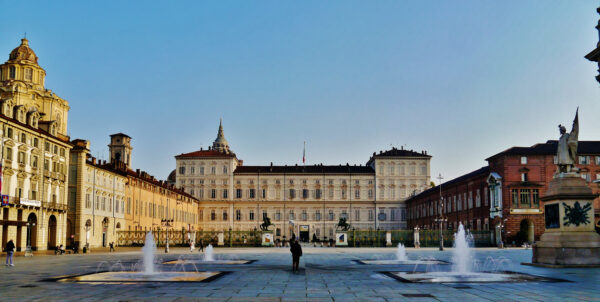
And yet the public square is irreplaceable, as though it held up the entire architecture of the city and were destined to endure through the ages, even in times of darkness. Let us look at it at this beginning of the century, which seems to be repudiating every certainty we thought we had achieved as the twentieth century fulfilled its destiny, with democracy finally having won its long struggle against dictatorships. I shall choose Piazza Castello at random, in the heart of Turin, the city I consider my own. I want to discover it as Gramsci saw it when, in the mornings, he climbed with his comrades towards Monte dei Cappuccini. From the hilltop, everything was visible, and the rest could be imagined. The old streets, whose ancient names in dialect were still preserved by the common people; the gates opening through the city walls. Then the roundabout known as “della Forca” (the Gallows), where executions by hanging took place, with the executioner living in Via dei Fornelletti, while the Inquisition met in Via Bellezia, near the Church of the Consolata, whose walls were covered with paintings of sacred wonders and popular miracles, preserved in the venerable tradition of votive offerings. And the eighteenth-century academy buildings, with their mysterious names: the United Ones, the Shepherds, the Unanimous, the Thunderstruck, the Solitary Ones, the Nameless, the Immovable. But there, in the distance, the dome housing the Shroud begins to emerge, its revered cloth, venerated as a holy relic, heralding the piazza. There is the Teatro Regio, too, where the evening lights would dim to signal that the royal procession’s carriages had departed from the Palace. The princesses could read the hierarchy of the boxes printed on their fans, allowing them to survey the city’s social pyramid at their leisure, without appearing to do so. Yet all of this disappeared within the long perspective of the arcades, the funnel through which every stroll seemed to pass, skirting the piazza’s metaphysical geometry. There were the trattorias with their animal names; the mezzanines where the milliners sewed, exchanging remarks with the students passing below; the cafés, with their glass, marble, stucco and velvet, their tamarind drinks, billiard tables and sour-cherry liqueur; the doors studded with decorative upholstery; and the King, who would open his morning audiences by asking: “What are they saying at Café Florio?”
It is precisely the cafés, the natural companions of the public square, that George Steiner considers “essential markers of the idea of Europe”. From Trieste to Florence to Turin, with Joyce, Ungaretti, Cardarelli, Longhi and Maccari; just as in Lisbon, Vienna and Paris, they represent the true everyday “meeting places and centres of conspiracy, of intellectual debate and gossip”, where one can let the clock idle. People greet one another and, in reality, exchange a daily sign of recognition and fellowship. It is the pleasure of time flowing by, passing between words, in a Europe built around cafés in its public squares, with men and women seated at little tables. It is a perfect but silent scene, like a suspended painting by Hopper. Yet something must be added to it: the art of exchanging time for friendship, familiarity and encounters, through a play of words with no immediate purpose, words spoken for the sheer pleasure of saying them, of freely offering them, asking for nothing in return but other words. Perhaps, in the end, things will come together again. And there, in the public square, seated at a café table, it will be the European art of conversation that saves us.
Translated from Italian by Antonin Charlin.
1 This café, founded in 1780, was a popular meeting place for artists, intellectuals, aristocrats and military officers. Charles Albert of Savoy was in the habit of asking what was going on there.
2 Giuseppe Ungaretti (1888–1970) was one of the greatest Italian poets of he twentieth century; Vincenzo Cardarelli (1887–1959) was a poet and journalist; Roberto Longhi (1890–1970) was an art historian; and Cesare Maccari (1840–1919) was a painter and sculptor.