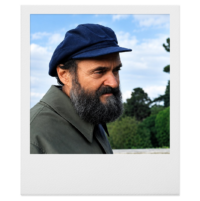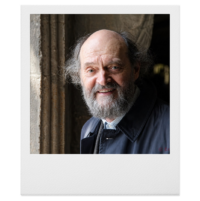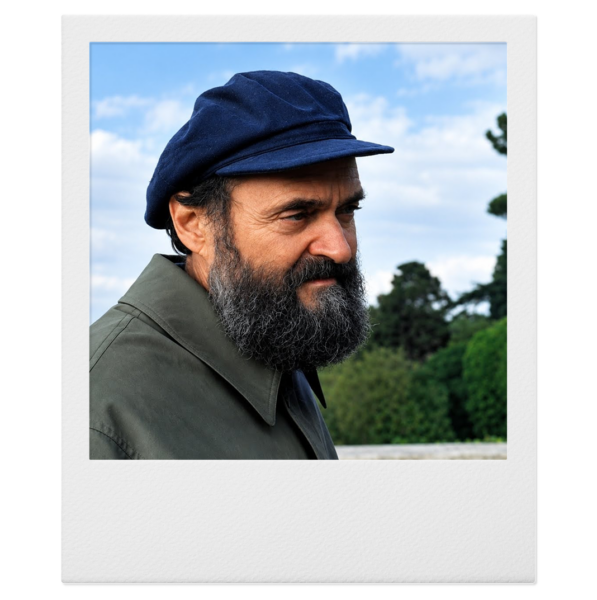
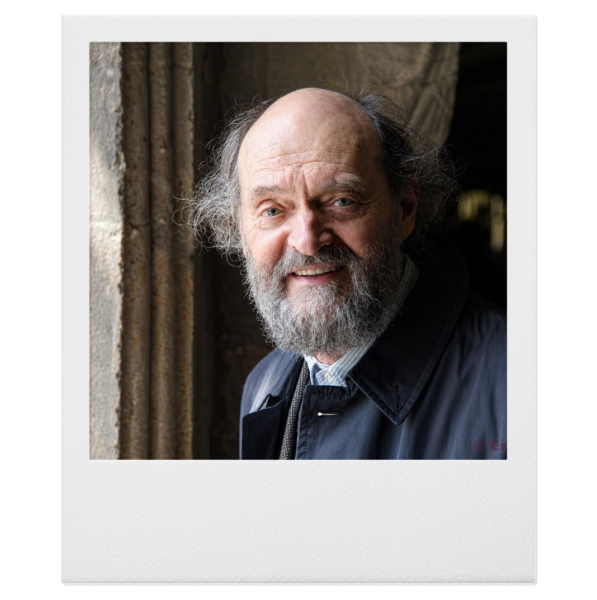

The first time I travelled to Estonia was in 2015. On the occasion of Arvo Pärt’s 80th birthday, the American director Robert Wilson was staging an theatre production of some of the composer’s works in a former shipyard in Tallinn. The day before, I drove out with a couple of other journalists to Pärt’s home on the Laulasmaa peninsula, three-quarters of an hour through endless pine forests. His son, Michael, was there to receive us; sometime later, the composer himself joined us. Unexpectedly and almost inconspicuously, without saying terribly much. As we were leaving, he helped me into my coat.
I had previously written a couple of newspaper articles about Pärt’s music. Lots of colleagues, I learned, were wary of it, almost derisive. But in the same time that Pärt was one of the most-played composers of contemporary classical music, if not the most played; plenty of people were downright addicted to that clear, predominantly calm sound. I asked Eric Marinitsch, who had worked with him for many years at Universal Edition in Vienna, whether it might be possible to arrange a meeting. Pärt didn’t give interviews, was the answer I received by email. However, he would be glad to speak with me in the summer, in Salzburg, during rehearsals for the Vienna Philharmonic’s performance of his “Swansong” at the Salzburg Festival. As usual, I went to the hotel a little before the appointed hour and asked at reception if they could call up to Pärt’s room. The receptionist nodded briefly at a sofa in the foyer. “That’s him there.” I hurried over to the composer; I’d never experienced anything like this with a prominent musician before. Was I too late, had the wrong time been communicated to him? “I didn’t want to make you wait,” said Pärt, who sat with a slender, somewhat battered leather bag on his lap. We went on to speak, in German, for an hour and a half, about this and that – chiefly how rehearsals were going, everyday life for a composer. Pärt had lived for thirty years in Berlin after emigrating from Estonia in 1980. One thing was certain: this wasn’t a conversation with a murmuring mystic.
Only with hindsight did I realise why Pärt does this kind of thing – helping a journalist, one among many, into his coat; arriving ahead of time and sitting on a sofa to wait. Humility. Something that confused me in the first instance; shamed me, even. Humility is a virtue that is easily misunderstood, because it isn’t aimed directly at an interlocutor. Instead, it takes a circuitous route via God, via the divine spark that the humble assumes in all people. And it is, in a certain sense, the ultimate Christian virtue, unsettling even to Greco-Roman antiquity, when people emphasised their own status as a matter of course and measured it against that of others.
An association with Christianity is omnipresent in Pärt’s work, as self-evident as in no other composer’s of recent decades, unless perhaps Olivier Messiæn’s. His vocal works are based almost exclusively on the texts of various Christian denominations; the titles of some of his instrumental works also suggest a religious context. Faith played an important part in his emigration from Soviet-ruled Estonia, exacerbating his conflict with the cultural authorities – in 1972, Pärt had converted to Orthodoxy. It is also one of the reasons he has at times been looked down on by members and professional observers of the western cultural industry. Messiæn’s work may often be religious in content, but stylistically it fits in with the many musical currents of the 20th century. For Pärt, however, humility is also a good attitude with which to approach his compositional style. “I have discovered that it is enough when a single note is beautifully played,” is perhaps his most oft-quoted sentence. “This one note, or a silent beat, or a moment of silence, comforts me. I work with very few elements – only one or two voices. I build upon a primitive material like a triad or a specific key. The three notes of a triad are like bells. That’s why I called it tintinnabulation.”
When Pärt developed his very own style of composition in the early 1970s in Estonia, he was searching for radical reduction in all parameters: sonority, harmony, melody, timbre, rhythm; an abundance of compositional tools that had positively ballooned since the mid-19th century and only kept on diversifying. Tintinnabuli – from a Latin word for “little bells” – can be described in essence as two principles that come together in one system; in musical terms, the two simplest principles of European music: the triad and the scale, which in Pärt’s work is usually in a minor key, though not in an old, functionally harmonic sense. Pärt views the triad as the established, resting element, the scale as one that develops over time; existing and becoming, objectivity and subjectivity, eternity and transience. Or, as he once put it: “My melodies are sins; tintinnabuli, the forgiveness of sins.” Robert Wilson’s aesthetics for the Tallinn shipyard were very good – so I wrote in the newspaper at the time – because they allowed plenty of room for contemplation. They were, however, a little too nicely packaged, slightly too smooth in their beauty; they were missing the darkness that is always audible in Pärt’s music, inextricably interwoven with its luminosity. Look at a medieval painting from a distance, and we often see only the gold background surrounding the figures. But those figures are performing against that backdrop, making concrete gestures, and if the painter was good we can read in their faces that they suffered and would pass away.
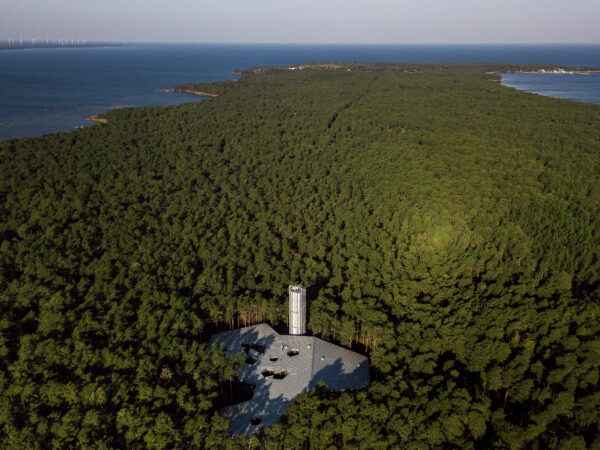
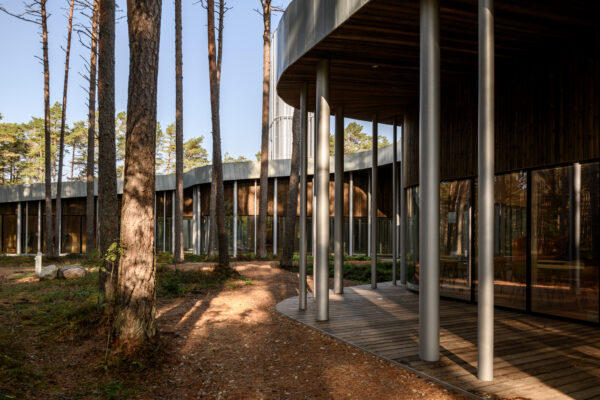
In 2018, I travelled again to Estonia, for the opening of the Arvo Pärt Centre, which had been built in the immediate vicinity of Pärt’s home. In 2010, he had returned to his homeland for good; it was no coincidence that the opening of this new building dedicated to his work fell on the same date as the 100-year anniversary of Estonia’s first declaration of independence. The Arvo Pärt Centre houses the composer’s manuscripts in the proper conditions for modern conservation; there is a research department attached, along with a large library. The wood-and-glass building appears almost unnoticeable, hidden beneath the canopy of the pine forest. On Pärt’s request, the architects added a high tower, much like a church spire. Climb it and you can look out into the distance, far above the treetops, to the expanse of sea surrounding the peninsula.
The opening-night concert brought together the upper echelons of Estonian politics, and yet it was a relaxed affair. In their speeches, they betrayed an intimate knowledge of Pärt’s music, of the kind one would no doubt have to search long and hard for among western politicians. Finally, Pärt himself sat down at the piano and played a two-and-a-half-minute waltz, almost childish in its simplicity, composed in 1973 for the film Ukuaru. Those were his years of self-discovery, in which he composed his third symphony and otherwise wrote nothing but film scores to earn a living. But a childlike approach is a constant in his oeuvre, whether in the “Five Children’s Songs” of 1960 or the two lullabies he composed in 2002 for a recording by conductor and viol player Jordi Savall. And, of course, in “Für Alina” and “Variations for the Healing of Arinushka”, two of the earliest, shortest but still most iconic fruits of the tintinnabuli style, the first named after the daughter of friends, the second after his own. “Unless you change and become like little children, you will never enter the kingdom of heaven…”
In the middle of the Arvo Pärt Centre is a small chapel built in the Grecian style, with frescoes depicting two saints whose writings play an important role in Pärt’s work: Silouan the Athonite, who lived a secluded life on Mount Athos in Greece, and his student Sophrony. The idea is that the chapel looks as though it has always been there, with the Centre having grown up around it – just as the triad and the scale were there before Pärt, having developed in the course of European music history. They could have developed differently, as in tonal systems from outside Europe. Even their individual notes are ultimately contingent, a pragmatic solution within the equal temperament system. Many composers of the late 20th century demonstrated this by splitting them up, adding extra tones to make sounds that had previously been regarded as secondary noise. Pärt treats it as a given, the primitive material that is available for use like the wood of the pine forests, no matter how it grew. It brings to mind another sentence from the Bible: “The stone that the builders rejected has become the cornerstone…” In much the same way, Pärt set to music many texts that had already been set to music by hundreds of composers before him: the words of the Catholic mass in the “Missa syllabica” and “Berlin Mass”, the Passion in “Passio Domini nostri Jesu Christi secundum Joannem”, the “Magnificat” and the corresponding “Seven Magnificat Antiphons” for Advent. His selection encompasses liturgies and legends from the different denominations of Christianity, as well as their common languages: the traditional liturgies in Latin and Church Slavonic, the newer ones in English, German and sometimes French or Italian. Here, too, there seems to be no desire to be unusual.
But carelessness about language this is not. Alongside his tintinnabuli style, Pärt has developed a system for dealing with text that is orientated along the progression of individual words. Setting words to music is something he considers to be a form of musical tracing, an act of humility in the face of the word – perhaps the divine word – in each of the historically developed languages he encounters. Sonic gestures are part of this, deployed symbolically: such as in “Salve Regina”, where passage through the vale of tears is indicated by plucked string basses, or in “O Adonai”, the second Magnificat Antiphon, where the choral bass uses a sustained open fifth to symbolise the strict laws of the Old Testament that accordingly underpin Christianity. These are gestures akin to those made by the figures in medieval paintings, pointing both to and beyond something.
Many of Pärt’s instrumental compositions are also inspired by texts; 2008’s “Symphony No. 4 Los Angeles”, for example, takes up an Eastern Orthodox canon to the guardian angel. Pärt wrote his last symphony on commission from the Los Angeles Philharmonic; he dedicated it to Mikhail Khodorkovsky, an oil executive and critic of the Kremlin who was incarcerated in Russia at the time. An unusual move, perhaps, given that Pärt doesn’t make public statements on political questions, but undoubtedly one that demonstrates how his youthful experiences with the Soviet Union had continued to have repercussions, as indeed could be said of many Estonians.
Symphony No. 4 is written in Pärt’s later style, which saw him use tintinnabuli less rigidly than in the years of its breakthrough. Both central elements open up into greater multiplicity: the triads seem less static and instead begin to move back towards the functional relationship they had in the classical and romantic tradition; the scales also unfold into a greater range of tonal expression. It would be possible to view this as a weakening or softening of Pärt’s own principles; then again, it could be seen as a new form of freedom, Pärt treating his own system as one that is also contingent, so to speak, necessary for one form of radicalism but malleable within that. Over the past few decades he has also continually revised his older works. Even well-known pieces can sometimes exist in a confusing number of versions: “Fratres” for viola, string orchestra and percussion, for violin and piano, for string or saxophone quartet; “Pari intervallo” for organ, four recorders or eight cellos. Some instrumental works are also variations on vocal works; the “Swansong” mentioned at the beginning of this article is an approximate orchestral version of the “Littlemore Tractus”, in which Pärt set excerpts from a sermon by the English cardinal John Henry Newman to music for a choir. Timbre – which as an element, alongside harmony, has diversified most since the mid-19th century – seems to hold the least significance for Pärt. This is much like early music, in which the solo part in a concerto can often be taken over by a different instrument; not inconsequential for the tonal construction as a whole, yet still depending on whatever instruments were available. The essence is still the fabric of voices. Accordingly, Pärt has also authorised adaptations by third parties, most recently for the young Lithuanian pianist Georgijs Osokins, who wanted to be able to include “Fratres” in a recording of Pärt’s piano music.
Becoming acquainted with Pärt’s music is a process that demands humility of its performers as well. His vocal oeuvre, in any case, is dominated by choral works in which the individual voice contributes to the sound in its entirety. Vocal extremes are rarely required, with the exception of the deep basses that add an eastern flavour, and in his instrumental works, too, virtuoso qualities are seldom sought. Yet sloppiness quickly gets its revenge onstage. It may be enough if a single note is played beautifully, but one does have to be able to play it beautifully in the first place. Here, ensembles like the Estonian Philharmonic Chamber Choir and Vox Clamantis, who have been working with Pärt for a long time, achieve a density, a fire and an internal radiance into which Central European choirs must first compel themselves.
And yet it would be impossible, these days, to imagine anywhere in western Europe without Pärt’s music. It has written itself into a history of reduction in which Pärt may not be such a lone wolf as some superficial reactions to his work would claim. The more the compositional toolbox expanded, the more frequent became the calls for a new simplicity: from the later works of Franz Liszt, who also professed himself a Christian and forsook all the former gloss of virtuosity in his compositions; through Morton Feldman, who allowed individual notes and the silence between them to speak for themselves; to the new orbiting of triads in minimal music. Perhaps this is a story that needs to be written one day: the secret history of humility in composition. Pärt, now 91 years old, would certainly not take the most inconspicuous place within it.
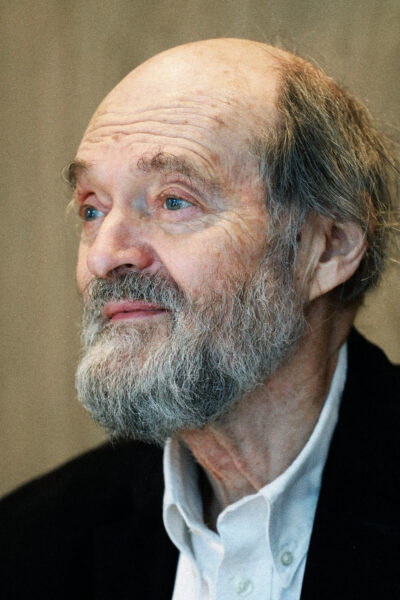
The last time we met, in the little chapel at the Arvo Pärt Centre, we spoke to one another of this and that, everyday things, just as we had the first time. Unlike the Catholic churches of the west, Orthodox churches don’t enforce any kind of mystical silence; they are spaces for humanity, in all its comings and goings and conversations. The afflictions of old age were noticeable in Pärt, and yet he didn’t complain. Old age, if nothing else, will demand humility of us all. Afterwards, I climbed the tower again and looked down: beneath the pine trees, Pärt was walking away, following a narrow path. His music will continue to tell us where it is that we have come from, and where to, perhaps, it is that we will return.
Translated from German by Eleanor Updegraff.
Photos © Birgit Püve