“As he listened to the cries of joy rising from the town, Rieux remembered that this joy was always under threat. For he knew what the jubilant crowd did not know, and what can be read in books: the plague bacillus never dies or disappears for good; it can lie dormant for decades in furniture and linen; it waits patiently in bedrooms, cellars, trunks, handkerchiefs and papers; and the day might come when, for the misfortune and instruction of mankind, the plague would rouse its rats again and send them forth to die in a happy city.”
Albert Camus, The Plague
On the eve of the Second World War, in May 1939, the French socialist Marcel Déat, who would later become a collaborator and fascist under the Vichy regime, was trying to convince his compatriots that Poland was not worth intervening in, that “it was not worth dying for Gdańsk.”
His pacifism and isolationism reflected the prevailing mood of public opinion in France at the time. This was hardly surprising: France, like the other European democracies, was still bearing the trauma of the Great War. No one wanted to relive Verdun, the Marne, the Battle of the Carpathians, or the Italian Alps; no one wanted to see a repeat of those senseless massacres described by Erich Maria Remarque, those slaughterhouses in which men were killed in the name of the imperial and colonial interests of Europe’s great powers.
Military cemeteries, where former enemies now lay side by side in a shared and peaceful silence, were becoming overgrown with grass. People wanted to live in tranquillity and peace.
Europe was losing interest in “quarrels in faraway countries, between people of whom we know nothing,” as British Prime Minister Neville Chamberlain had declared during the Sudeten crisis in 1938, on the eve of the shameful Munich Conference.
Today, after two great world wars that Europeans unleashed against one another, and faced with the prospect of a third, we now understand that these “faraway countries” are an integral part of our continent, and that the plague bacillus brought in from those regions will sooner or later reach the great historic capitals, right into the heart of Europe itself: Paris, Rome, Madrid, Berlin or London.
***
I was born in a city “far away” from Europe’s great metropolises, among people about whom little is known and in whom no one is interested. I was born in Gdańsk. I do not know whether there is another place on the map of Europe that so eloquently embodies the tragedy, but also the hope, of European history. Perhaps only Sarajevo…
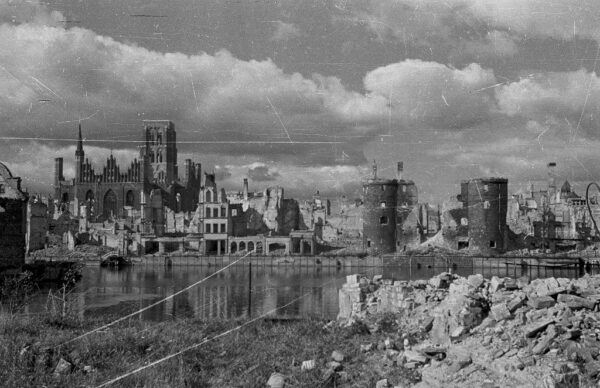
I was born in the 1960s, amid the ruins of the old Hanseatic Gdańsk, in communist Poland. At the time, one might have thought that, for all practical purposes, everything was already over; that nothing could bring the old Free City back to life; that the history of this civitas, this Venice of the southern Baltic, had come to a definitive end.
The city was now but a shadow of its former self. Eighty per cent destroyed by the Red Army, stripped of its original Gdańsk inhabitants, it had become a drab port city, its historical continuity brutally severed, populated by Poles driven from their homes in the East, in Lviv or Vilnius. Bewildered newcomers, uncertain of what the future held, moved into the warm houses that the Germans had heated before their departure, at least those that had somehow miraculously escaped destruction, where everything was unfamiliar to them. This was post-war Europe, in the aftermath of the plague epidemic.
***
Our street should have been called “Scarlet Oak Avenue”: that name would, in fact, have been truer to its character. I have no idea why, before the war, the German authorities of the Free City of Danzig had decided to line this avenue with trees native to the east coast of North America. In autumn, their leaves turned yellow and red, and at the slightest breath of wind, acorns came raining down on passers-by in a dense hail. As children, we collected them in shoe bags and took them to school to feed the animals at the Oliwa Zoo. A new life was unfolding at our feet, and we asked no questions.
Only occasionally, on our way home from church, would we encounter two grey-haired neighbours chatting away in an incomprehensible Gdańsk dialect: Plattdeutsch. This language of the Hanseatic League, steeped in the influences of port life – English, Dutch, Scandinavian and Kashubian –
could still be heard from time to time in the streets. Its strangeness both startled us and enveloped the place in an aura of mystery.
Before the war, our street had been called Friedrich-Allee, in honour of an Enlightenment monarch and father of Prussian militarism: King Frederick the Great, architect of the First Partition of Poland. A ruler who showed no mercy to the weak. Our neighbourhood was called Langfuhr, but after 1945 it became Wrzeszcz, a name presented as “Old Slavic”, so that no former resident of Langfuhr would be able to pronounce the new name of their neighbourhood.
Our home was a two-storey tenement building. It no longer displayed the characteristic ornamental features of Gdańsk Art Nouveau. In the stairwell of number 14, the floral motifs of the Art Deco stained-glass windows no longer shimmered in the sunlight; the banisters, though elegantly curved, bore not a single superfluous Baroque ornament. They possessed only the beauty demanded by the pragmatism and comfort of the people who had moved in there in 1927. This was not yet the modernist architecture that was beginning to flourish at the same time in neighbouring Polish Gdynia. Modern by the standards of the 1920s, our building made a mockery of the Communist propaganda narrative about Gdańsk’s age-old Polish character.
Every day, on my way home from school, with my key hanging around my neck, I would insert it into the German lock. I would open the letterbox bearing the word “Briefe” and wash my hands at a tap fitted with porcelain handles marked “kalte” and “warme”. Even the simple radiator valve displayed the same words, “kalte” and “warme”, which, for a seven-year-old boy, completely undermined my first attempts to put letters together and form Polish words.
In the kitchen stood a shining symbol of early-1930s modernity: a Junkers gas cooker. The bathwater was also heated by a Junkers gas water heater, which, sometime in the mid-1970s, suddenly began spewing soot and spraying boiling water in all directions, like a broken-down steam locomotive.
Even a child could sense the glaring discord between the spirit of the inhabitants and that of the place. Our Sarmatian temperament, with its moustaches and airs of traditional Polish nobility, fitted the Teutonic buildings, Dutch Mannerist architecture and monumental Prussian public buildings about as well as a saddle fits a cow.
The rough-hewn granite foundations, the clinker bricks laid with immaculate mortar joints, the basalt and granite cobblestones, the lack of imagination and the excess of Prussian rigour – that Ordnung – meant that my mother, like so many other newcomers to Gdańsk, never felt at home there.
In her eyes, it was a foreign city, a German city. She did not like Gdańsk, even though she had spent almost her entire life there and lived in the city until her death.
We, on the other hand, having been born in Gdańsk, had made it our little homeland, our Heimat, as the Germans driven from these places would have called it.
We were captivated by its mystery. The genius loci of this place had taken hold of our imagination and driven us to seek an answer to the question: where, exactly, am I?
***
A problem of broken continuity nevertheless arose. As the Gdańsk writer Paweł Huelle once observed, when a child asks the question “What is this house?” or “What is this stone?” in Kraków, Prague, Milan, Geneva or Madrid, the answer is comprehensive. My parents, by contrast, did not know the answers. For them, the history of Gdańsk began in 1945.
After years spent uncovering the different layers of the urban palimpsest and trying to understand the successive eras, the people, the sociology, geography, economy and history of this place, we eventually came to realise that we were living in a city which, for most of its history, had been neither Polish nor German, contrary to what nationalists on both sides of the Oder would have us believe. Gdańsk was a maritime republic, a profoundly European city!
It was a city of many cultures, a city of different languages, religions and peoples, a veritable Mecca of nations. Another Gdańsk writer, Nobel Prize-winning author Günter Grass, wrote of it:
“When I realise the extent to which Flemish builders, settlers from Holland and Scotland, Mennonites and Huguenots, English merchants and the Jews who made their home here all helped shape my Gdańsk, all national claims become insignificant.”
***
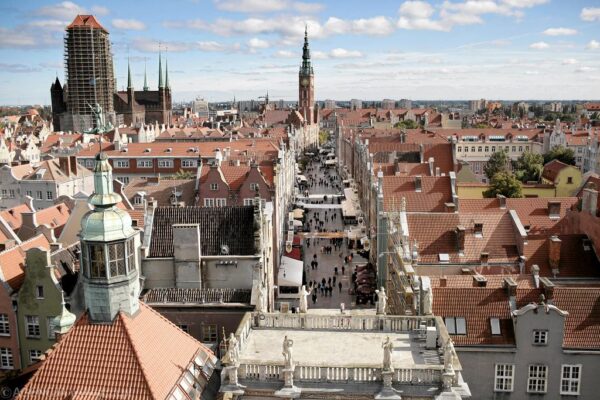
There is no doubt that, despite the considerable presence of Scots, Dutch, Jews and English from the fourteenth century onwards, the language spoken in the streets was German, and that the wealthiest group, the one that gave the city its economic importance, consisted of merchants from Lübeck.
There was nothing exceptional about this in Central Europe at the time: in Polish towns, too, the bourgeoisie was German and multicultural.
So what? It changes absolutely nothing. For the primary identity of Gdańsk’s inhabitants was not their nationality – that pernicious form of genetic determinism which emerged in the nineteenth century – but their citizenship, their sense of belonging to their city.
Gdańsk served the King of Poland because he guaranteed the greatest commercial profits through trade with Poland, granting the city the most advantageous privileges. Gdańsk thus became the most important city in Poland, the window on the world for a landlocked country, the link between maritime and river trade. The city accounted for three-quarters of the entire foreign trade of the Polish-Lithuanian Commonwealth.
According to the British historian Norman Davies, no fewer than 2,052 ships (!) entered the port of Gdańsk in 1642. As for the Lisbon merchant Andrés López Pinto, he sent no fewer than 200 ships to Gdańsk over a three-year period, from 1615 to 1618, to exchange salt for rye. Let us hear Davies himself: “The annual voyage down the Vistula had become a fundamental institution of Polish social life, an opportunity to discover the wider world, an adventure for generations of people whose experience of life was confined to the boundaries of their own farming estates. (…) What a wonderful place Gdańsk must have seemed to a visitor from some remote village deep in the countryside! In 1600, the city had a population of 50,000. It was a republic within a republic. It had its own municipal government, its own financial policy and its own mints, as well as its own army and naval fleet. In three thousand workshops, every imaginable luxury of the age was manufactured: velvet, silk fabrics, furniture, jewellery, books and paintings. Its inhabitants were familiar with all the latest news, the newest fashions and the latest heresies. They wore Spanish clothes and lived in houses built in the Flemish style. Gdańsk was a thriving centre of industry, prosperity and culture, a phenomenon well known in Italy and the Netherlands, but utterly without parallel in Poland.”
Thus, as early as the seventeenth century, Gdańsk was bringing Poland into Europe.
***
But this city ceases to be mine at the precise moment when it abandons its ambitions for political and economic autonomy; when it ceases to be a free Hanseatic republic and becomes the capital of a Prussian province, administered by a bureaucracy established by Frederick II according to the principles of enlightened despotism. When an administrative decree turns it into a monolithic entity, homogeneous in both national and religious terms.
Johanna Schopenhauer had no wish to live in this city, which had been annexed by the Kingdom of Prussia. A novelist, she was one of the most remarkable women of her time. A friend of Goethe and a familiar figure in literary salons, she was also the mother of the celebrated philosopher Arthur Schopenhauer. In March 1793, following the Second Partition of Poland, her family decided to emigrate at once, before Prussian troops could seal off the city’s borders. The Schopenhauers left in secret, abandoning a substantial part of their possessions and property behind. They settled in Hamburg, a free Hanseatic city, which guaranteed their independence and allowed them to continue their commercial activities.
Over the 152 years of Prussian rule that followed, from 1793 to 1945, Gdańsk gradually lost the memory of its earlier ties with Poland. In the nineteenth century, its German citizens were enlisted under the banners of Prussian nationalism. As the years went by, the people of Gdańsk came to see themselves as members of the emerging German nation.
This, then, is not my Gdańsk: the city where, on 25 April 1919, tens of thousands of inhabitants demonstrated at the foot of the monument to William I, protesting against the provisions of the Treaty of Versailles and demanding that the city be incorporated into the German Reich.
A new generation of German recruits, demanding justice for what they regarded as the humiliation of Versailles, was already growing up.
The rats began spreading the plague bacillus, which had until then lain dormant. The early warning signs of the epidemic were readily ignored by well-meaning people and soon afterwards by its first victims, just as the inhabitants of Camus’s Oran, full of good faith and illusory hope, refused to take the threat seriously.
***
And today, when I walk along Długi Targ, the prestigious thoroughfare of the Main Town, I cannot rid myself of an image that keeps returning to haunt me. It is September 1939. Following the annexation of the Free City of Gdańsk by the Third Reich, Adolf Hitler drives in an open-top Mercedes-Benz along the route once taken by the kings of Poland. He is greeted by a dense forest of arms raised in the fascist salute. Along the entire route, jubilant crowds acclaim him, swaying in a frenzy of convulsive exaltation. These ordinary people, these inhabitants of Gdańsk infected with the totalitarian bacillus of Nazism, these kindly grandfathers, loving fathers, devoted mothers, these chubby, trusting children, these rosy-cheeked young patriots, so eager to make their Prussian homeland pay for what they regarded as injustices and humiliations: all of them roared as if in a trance: “Heil! Heil! Heil!”
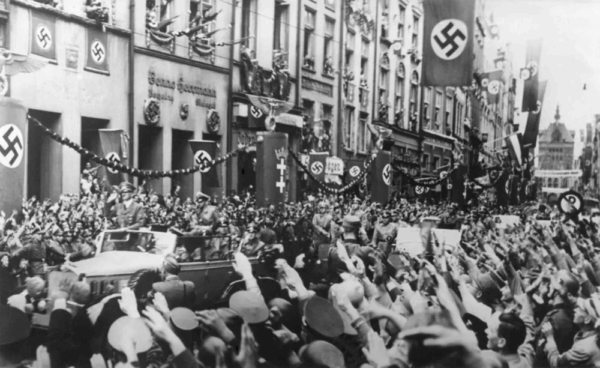
One of the protagonists in Jacek Sarnacki’s documentary Był sobie Gdańsk (Once Upon a Time in Gdańsk), an elderly resident of the city, recounts how, from his earliest days at secondary school, he had been taught to hate the Poles. His father had, after all, been killed by the Russians, but that made no difference to his feelings: “I would climb the tower of St Mary’s Church, raise my fist and swear revenge on the Poles. (…) At school, I had a Jewish friend. Yet, when I returned from one of the Hitler Youth camps, I pretended not to know him. I had been poisoned,” he recalls.
Gdańsk had now become a Nazi city.
Even Hermann Rauschning, an early dissident and exile who, like Dr Rieux, had warned of the plague, had himself been a member of the NSDAP and, on behalf of that party, President of the Senate of the Free City of Gdańsk. Who knows how his fate might have unfolded had he not lost the struggle for political power to Albert Forster, who would go on to become the future Gauleiter of Gdańsk? Even before the world experienced the true face of National Socialism first-hand, Rauschning had provided an in-depth analysis of it in The Revolution of Nihilism and Conversations with Hitler. But no one listened to the prophets, either in their own country or elsewhere. People do not want to hear bad news.
On 1 September 1939, a new world war thus broke out in Gdańsk. At five o’clock in the morning, the Polish military outpost at Westerplatte was bombarded by a battleship. France and Great Britain declared war on Germany, but no one, apart from the Poles under attack, was yet prepared to die for Gdańsk.
This was the beginning of the Phoney War. Like the inhabitants of Camus’s Oran, the states barricaded their doors and windows, convinced that all they had to do was wait for the epidemic to pass.
***
Gdańsk had been preparing for Adolf Hitler’s arrival for a long time. After Kristallnacht, none of the city’s eleven thousand Jews could harbour many illusions about their future. One Friday evening, as the Sabbath was drawing to a close, when SA men approached the Great Synagogue, where a service was in progress, a group of Jews came out to meet them: veterans of the Prussian army who had fought in the First World War and been decorated for bravery on both the Eastern and Western fronts. The synagogue was spared – but only temporarily. After October 1938, the Jewish community’s decision to sell all its property and places of worship to the city for the sum of 330,000 guilders, in order to finance emigration, was the best decision it could have made, before the window of opportunity for survival, briefly opened, closed for good. The majority of Gdańsk’s Jews managed to leave. Those who did not have time remained here, or in the nearby Stutthof concentration camp, never to return.The Nazis began demolishing Gdańsk’s Great Synagogue – one of the city’s most distinctive landmarks – on 3 May 1939, to the very day. They had first surrounded it with a wooden fence, on which residents of Gdańsk, impatient to see every last trace of it disappear, hung a banner bearing an inscription in Gothic script: Komm lieber Mai und mache von Juden uns jetzt frei – “Come, dear May, and finally set us free from the Jews.” Thus, by the time the Führer of the Third Reich entered Gdańsk four months later, not a single trace of Semitic architecture remained to disturb the city’s Aryan skyline.
The rest of the story of my Gdańsk is well known. Nobel Prize-winning author Günter Grass, himself a native of the city, portrayed it with painfully vivid realism in The Tin Drum. In his youth, he too had been infected by the plague bacillus and conscripted into the SS. Then came the massacres, the rapes, the fires and the death. Gdańsk became the antechamber of hell, for the Russians regarded the city as German. Those lucky enough to board the Wilhelm Gustloff perished in the icy waters of the Baltic, torpedoed by a Soviet submarine. The plague epidemic was reaping its harvest of death.
***
And yet I have written that Gdańsk is also a story of European hope, a city that rose from the ashes of the Free City like a phoenix. Was this the work of the place’s guardian spirit? Of its cosmopolitan port culture? Of the wind blowing in from the open sea?
Whatever the reason, Gdańsk became the most rebellious city in communist Poland, a self-proclaimed republic of free citizens who, in August 1980, under the leadership of Lech Wałęsa, launched mass strikes. These soon spread throughout Poland. Something unprecedented happened. In the heart of the communist bloc, Solidarity was born: a mass movement independent of the authorities. Here, in the very place where the first shots of the Second World War had been fired, the fall of the Berlin Wall began; here started the peaceful march towards freedom, the process of German reunification and the reunification of an entire Europe divided by the Iron Curtain which, according to Churchill, cut across the continent from Stettin to Trieste.
For one brief moment, peoples understood that there was no need to slaughter one another in order to move borders; all they had to do was open them. Today, Poles from Gdańsk can travel to Vilnius, the city of their ancestors, without a visa and without even stopping at the border. Likewise, Germans from Lübeck can make their way to their ancestral Gdańsk. But the same cannot be said of Lviv, the city of origin of so many Gdańsk residents.
An imperialist and bloody war, unleashed by Putin, is raging in Ukraine. He has understood nothing of the tragedy of the twentieth century. Once again, as in both world wars, innocent people are dying in the name of dictators’ paranoid ambitions, while new graves are being dug.
It all begins with verbal hatred and ends in bloodshed. Ten years have passed since the assassination of Paweł Adamowicz, Gdańsk’s democratic mayor, who was murdered while addressing the people of the city from the stage of a charity concert. His killer was a man who had been fed a steady diet of hatred and aggressive propaganda for years, disseminated by public media controlled by a far-right government.
Once again, from old trunks, papers, linen and the backs of paintings, the dormant plague bacillus is emerging, spread by feverish rats. Like Siamese twins, the extremist parties of Germany, Poland, France, Hungary, Slovakia and Italy, together with the insatiable politicians of the MAGA movement, are doing everything in their power to ensure that, before our very eyes, and to the misfortune and destruction of the inhabitants of this Oran of the southern Baltic, history repeats itself. They want the European republic, embodied today by my Gdańsk, to become a heap of ruins once again.
That is why we must defend the republic.